

When I decided to build a Sling TSi, I chose to do it through the Factory Build Assist Program offered by Sling Aircraft in Torrance, California. Rather than building the aircraft entirely on my own, I’ll be working on-site alongside experienced technicians who guide and support the process.
This approach still qualifies under the FAA’s Experimental Amateur-Built (E-AB) 51% Rule, as long as I complete the majority of the fabrication and assembly tasks myself. The program is designed specifically to ensure that builders stay compliant with these FAA requirements, while also gaining hands-on experience with all major systems and structures of the aircraft.
In this post, I’ll walk through how the 51% rule works, how Sling’s program ensures compliance, and how task points are distributed across the various build categories.
Understanding the FAA’s 51% Rule: Building for Education and Recreation
One of the things that makes the experimental aircraft world so special—and, frankly, so freeing—is something known as the FAA’s 51% Rule. If you’re like me and came into this process without ever having built an airplane before, it’s a regulation you hear about early and often. But it’s also a bit misunderstood.
The basic idea is simple: if you want your aircraft to be certified as Experimental-Amateur Built (E-AB), then you, the amateur builder, need to complete the “major portion” of the build—that is, more than 50%. This comes from 14 CFR § 21.191(g), and it’s what allows you to legally fly your homebuilt aircraft for personal, non-commercial use.
But here’s the twist most people don’t realize: the FAA doesn’t define “major portion” by how much time you put in. It’s based on a points system.
It’s Not About Time—It’s About Tasks
Each eligible kit (like the Sling TSi or Sling 4) is evaluated by the FAA’s National Kit Evaluation Team (NKET). They break the build into a long list of fabrication and assembly tasks—167 total points in the case of the Sling 4 Quickbuild kit. Each of these tasks is worth a number of points, and that point is divided across four categories:
- A: Manufacturer (the kit maker)
- B: Commercial assistance (like a hired shop)
- C: Amateur builder — assembly
- D: Amateur builder — fabrication
For your aircraft to qualify under the rule, you must personally complete over 50% of the total points—so, at least 167*51%=85.

Now, if you’re picturing yourself drilling thousands of rivets and fabricating every little part from raw materials, you can relax. The FAA’s checklist rewards non overly repetitive contributions, not necessarily harder or longer ones. In fact, many repetitive or time-consuming tasks (like skin riveting) earn very few points, even if they take hours to complete.
How the Sling Build Assist Program Makes It Work
This is where the Sling Factory Build Assist Program comes in. It’s carefully designed to make sure you meet the FAA’s 51% requirement—not just on paper, but with meaningful involvement in your airplane’s construction.
Instead of spending two years building a plane from the ground up, you’ll come to the factory for minimum 14 working days spread over 3–4 visits but a builder can choose to be more involved with additional visits. During those visits, you’ll tackle specific high-value tasks, always under the guidance of experienced technicians.
Here are a few examples pulled straight from the FAA’s official Sling 4 checklist for the Fabrication and Assembly Tasks:
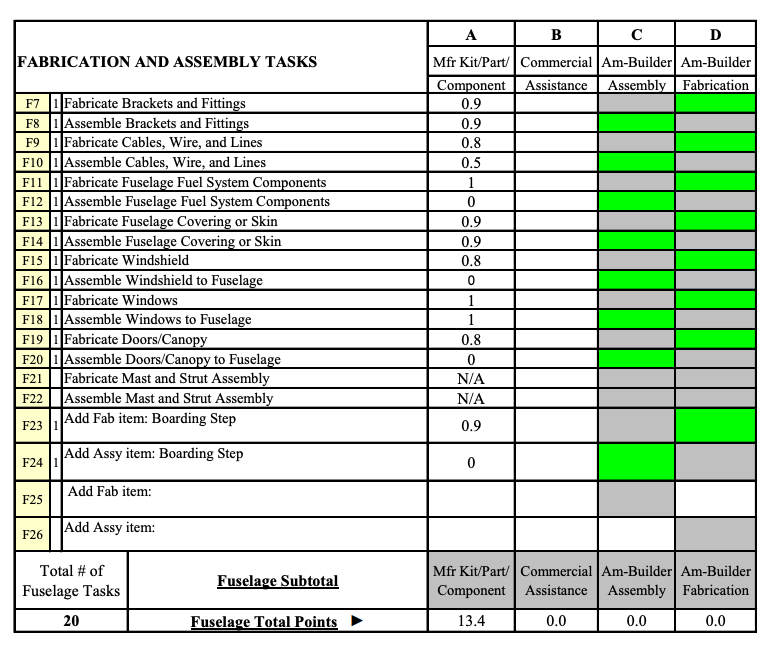
So even if you’re only with the airplane a few weeks total, you’re completing dozens of high-point tasks, each selected to keep you well above the 51% threshold (at least 85 points) while giving you hands-on exposure to every critical part of the airplane—empennage, wings, interior, firewall forward, and more. Here is how the totals are calculated in the spreadsheet:
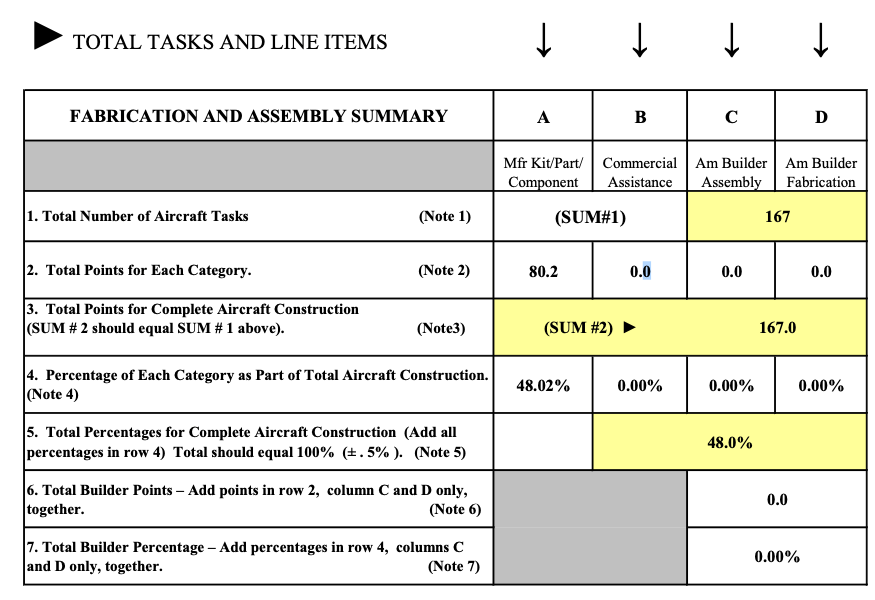
The factory takes care of much of the lower-value but labor-intensive work (like riveting fuselage skins), which often earns just 0.1 or 0.2 points despite taking hours.
Task Breakdown by Category
Let’s take a closer look at how the FAA tasks are distributed across categories in the Sling 4 build. Each category has a number of tasks and point assignments. Here’s the breakdown:
| Category | Total Tasks | Manufacturer Points | Builder-Eligible Points |
|---|---|---|---|
| Fuselage | 20 | 13.4 | 6.6 |
| Wings | 42 | 23.7 | 18.3 |
| Empennage | 42 | 16.0 | 26.0 |
| Landing Gear | 12 | 4.1 | 7.9 |
| Propulsion | 26 | 12.1 | 13.9 |
| Cockpit/Interior | 25 | 10.9 | 14.1 |
| TOTAL | 167 | 80.2 | 86.8 total points |
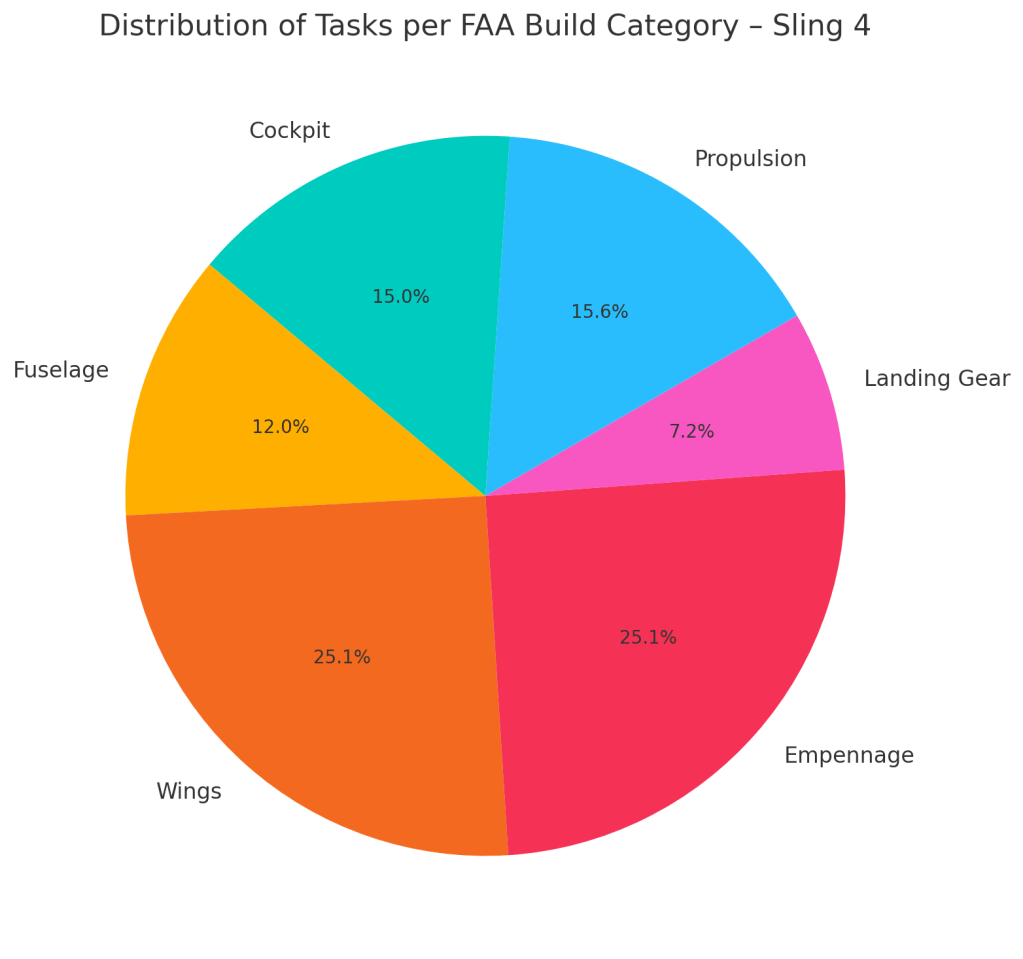
The Empennage offers the largest builder-eligible point total (26.0), covering tasks like:
- Assembling the horizontal and vertical stabilizers
- Installing rudder and elevator linkages
- Mounting control stops and cables
The Wings come next (18.3 points):
- Attaching wing skins and ribs
- Installing fuel lines, pitot/static tubes, and control surfaces
- Connecting flaps and ailerons
The Propulsion category is another key area (13.9 points):
- Mounting the engine to the firewall
- Installing exhaust, coolant lines, airbox, and intake system
- Bolting on accessories and sensors
Even smaller categories like Landing Gear (7.9 points) and Cockpit (14.1 points) have tasks that allow you to meaningfully contribute:
- Installing brake pedals and master cylinders
- Running static and fuel lines
- Installing seats, seat belts, canopy, and glare shield
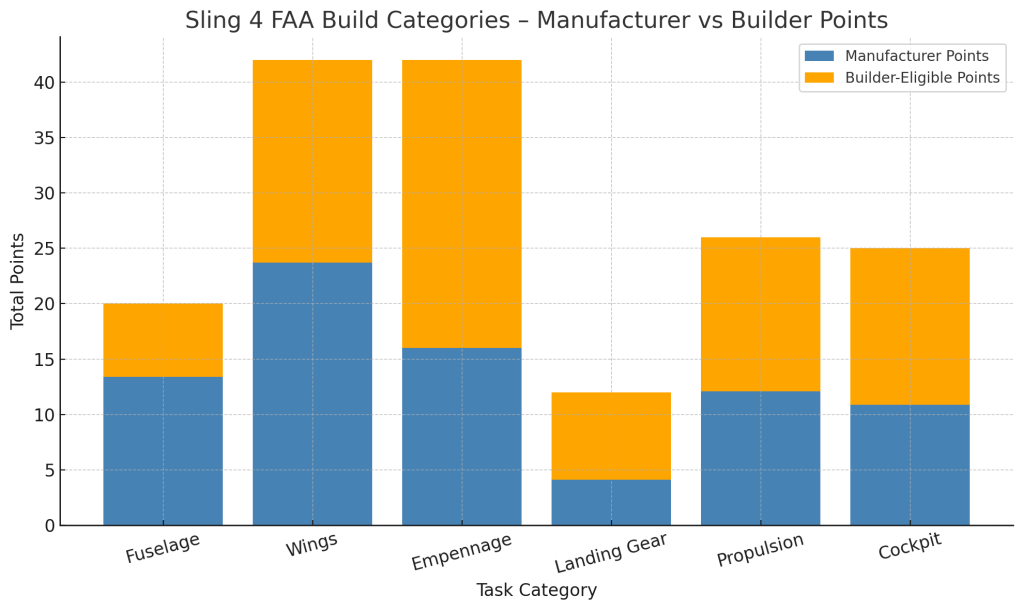
As the chart shows, Wings and Empennage dominate the task count—but they’re also where a builder can earn the most credit.
Commercial Partners Like Midwest Panel Builders
In my case, I’ve chosen to work with Midwest Panel Builders to fabricate and wire my avionics panel. This is a highly technical area—routing dozens of wires, terminating connections, and integrating multiple Garmin systems—so using a professional shop makes sense.
However, FAA rules mean any task they complete (e.g., panel design, wiring harness creation, mounting avionics trays) is credited to Column B: Commercial Assistance. If I participate in installation—say, drilling the panel into place, connecting the harness, or testing functionality—I may still get some credit under Column C.
That’s why it’s essential that:
- My panel vendor works in coordination with Sling
- I’m present during installation
- The build team properly documents my involvement
This allows me to benefit from professional expertise while still meeting the builder requirement.
It All Adds Up
At the end of the process, you’ll sign off on the same checklist the FAA uses, along with Form 8130-12 (Eligibility Statement), affirming that you built the major portion of your airplane. And you’ll have the documentation to back it up—photos, logs, and official sign-offs—prepared with help from the Sling team.
Wrapping Up: Staying Compliant, Staying Involved
The Sling Factory Build Assist Program is structured specifically to help builders meet the FAA’s 51% rule while still delivering a high-quality, safely assembled aircraft. With clearly defined tasks, proper documentation, and active participation in key areas of the build, the program ensures that each aircraft truly qualifies as amateur-built—without leaving the builder on their own.
While I’ll be getting expert help and support along the way, the responsibility for a significant portion of the fabrication and assembly remains mine. That’s not just a legal requirement—it’s a core part of what makes this aircraft mine.
Of course, completing the build is only part of the process. Once the aircraft is finished, it must undergo an FAA airworthiness inspection and then begin Phase 1 flight testing—a minimum 40-hour period flown solo in a defined test area to evaluate performance and reliability. I’ll cover that next stage, from inspection through first flights, in a separate post.
Stay tuned.




 Slingology - Building and Flying a Sling TSi
Leave a comment