
Slingology MX started with a very specific problem: keeping aircraft maintenance, compliance, and records coherent. Not just stored somewhere, but structured in a way that reflects how owners actually think about their airplanes—maintenance tasks, directives, counters, equipment, notifications, and the slow, relentless march of time and hours.
That foundation hasn’t changed. Slingology MX is still, first and foremost, about knowing the technical state of your aircraft and being able to answer uncomfortable but important questions with confidence:
Is this airplane compliant?
What’s coming due next?
What changed, when, and why?
But if you’ve owned an airplane for more than about five minutes, you already know something else is always running in parallel.
Money.
Not just big-ticket items like engines and avionics, but the steady drip of inspections, consumables, subscriptions, training, insurance, hangars, and “oh, right… that too” expenses. Most owners track this somewhere else—spreadsheets, accounting software, notes apps, or vague mental estimates that feel accurate right up until they aren’t.
This month, Slingology MX grows into that missing half of the picture.
Not by becoming accounting software.
Not by replacing your tax tools.
But by connecting financial reality directly to aircraft activity, using the same philosophy that guided maintenance tracking from day one: structured records, minimal duplication, and automation where it actually helps.
What follows is an overview of the new financial capabilities now part of Slingology MX: the new record types, how they relate to real-world ownership activities, and the insights they unlock once cost data stops living in isolation.
The New Financial Building Blocks
To make financial data useful, Slingology MX treats it the same way it treats maintenance and compliance: as structured records with clear intent, not a pile of numbers in a ledger. The goal isn’t bookkeeping for its own sake. The goal is clarity.
That starts with three new record types.
Transactions: Where Money Becomes Fact
Transactions are the atomic truth of the financial system. A transaction represents a real movement of money tied to aircraft ownership: an inspection invoice, an oil change, an avionics subscription charge, a hangar payment.
There’s no forecasting here. No assumptions. Transactions answer one question only:
What actually happened?
Some transactions are entered manually. Many are created automatically as a side effect of other actions in the system. Either way, once a transaction exists, it becomes part of the permanent financial history of the aircraft.

This is intentional. Transactions are boring—and that’s a compliment. They are the ground truth everything else builds on.
Commitments: Why Subscriptions Were Reframed
If you’ve used Slingology MX before, you’ll notice that Subscriptions are gone. They’ve been replaced with Commitments, and that rename wasn’t cosmetic.
A subscription is narrow. It implies software, monthly billing, and little else.
A commitment is broader and more honest.
Insurance premiums.
Hangar rent.
Chart services.
Data plans.
Recurring training expenses.
These aren’t optional, and they aren’t surprises. They’re commitments you’ve already made, whether you like them or not.
In Slingology MX, a commitment represents a recurring financial obligation, including:
– cadence
– expected cost
– next occurrence
– and its relationship to actual transactions over time
This lets the system do something important: connect expectation to reality. You can see what you thought something would cost, and what it actually did cost, without juggling tools.
Reserves: Making Future Costs Visible
Reserves are where long-term thinking enters the picture.
A reserve represents money you should be setting aside for future events that are inevitable but not immediate: engine work, prop overhauls, parachute repacks, major inspections, upgrades you already know are coming.
Reserves are not expenses.
They are not transactions.
They are intent.
Their purpose is simple: prevent future-you from being surprised by past-you’s optimism.

By tying reserves to counters, time, or known events, Slingology MX makes future costs visible before they arrive, not after they hurt.
When Aircraft Activity Creates Financial Reality (Automatically)
One of the core ideas behind Slingology MX has always been that records should not exist in isolation. Maintenance affects compliance. Counters affect inspections. Time affects everything.
Financials follow the same rule.
Instead of asking owners to re-enter the same information in multiple places, Slingology MX treats financial activity as a consequence of real aircraft activity.
Maintenance That Generates Transactions
When you record a maintenance task in Slingology MX, you already capture what matters: what was done, when, why, and under what conditions. In many cases, you also know the cost at the time the work is performed.
Now, that cost doesn’t just sit in a description field.
When a maintenance entry includes financial information, Slingology MX automatically creates the corresponding transaction. No second form. No duplicated data. The maintenance record and the financial record stay linked, so you can always trace a cost back to the work that caused it.
This matters more than it sounds.
It means you can later answer questions like:
– How much did this inspection really cost over time?
– What portion of my annual spend is maintenance vs. fixed overhead?
– Which activities are quietly expensive, even if they don’t feel dramatic?
And you get those answers without doing extra work at data entry time.
Commitments That Turn Into Reality
Commitments work the same way, but on a timeline.
A commitment defines what should happen: a recurring cost, its cadence, and its expected amount. When that date arrives, Slingology MX can generate the corresponding transaction automatically.
This does two things at once:
– It reduces missed or forgotten costs
– It creates a clean comparison between expected and actual spend
Over time, this builds a financial history that reflects how ownership actually behaves—not how you hoped it would behave when you set things up.
Automation here isn’t about cleverness. It’s about removing friction so the system stays accurate without becoming annoying.
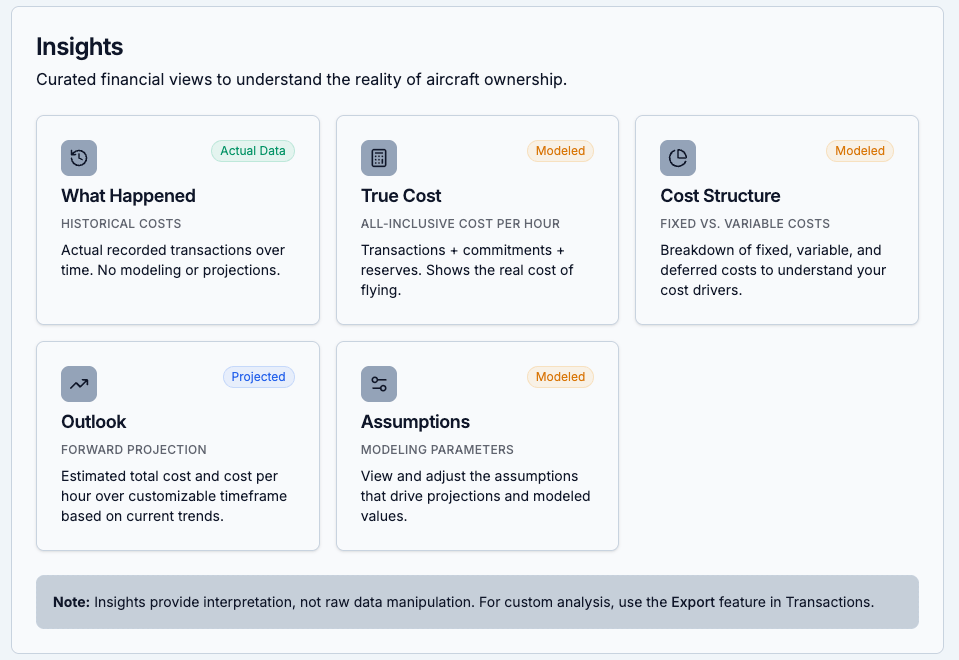
Financial Insights: Five Ways to Understand Ownership Reality
The financial insights in Slingology MX are designed around questions, not reports. Each insight answers one specific ownership question, using real data already captured by the system. Together, they form a layered understanding of cost: past, present, future, and the assumptions that connect them.
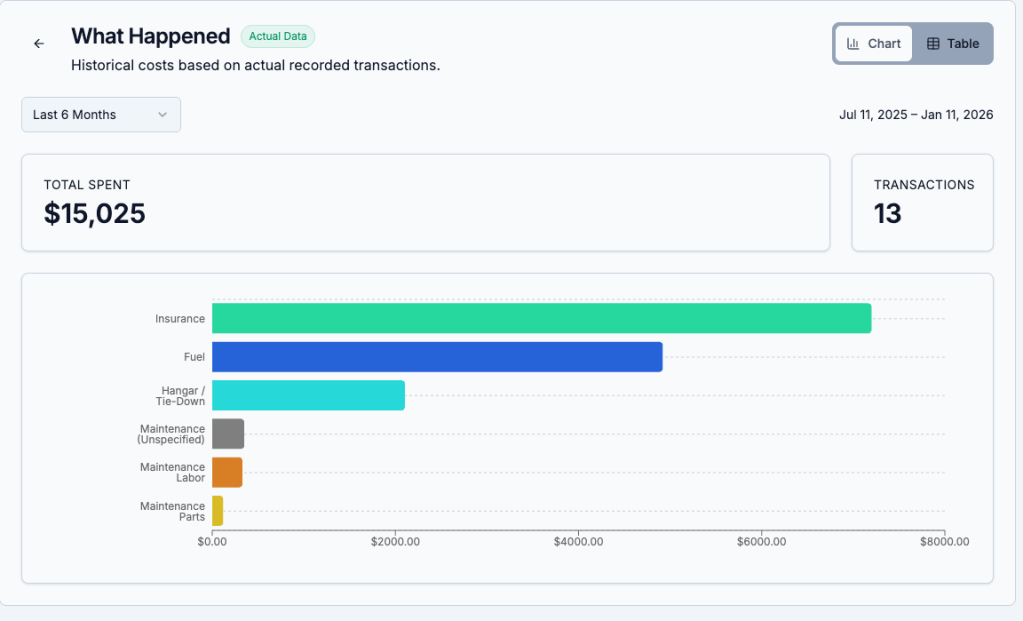
What Happened
This is the factual baseline.
What Happened shows historical financial activity based on actual transactions. No forecasts, no smoothing, no interpretation. Just a clear view of money that was spent, when it was spent, and how it accumulated over time.
This insight exists to anchor everything else. Before asking why something cost what it did—or what it might cost next—you need a shared, objective record of reality.
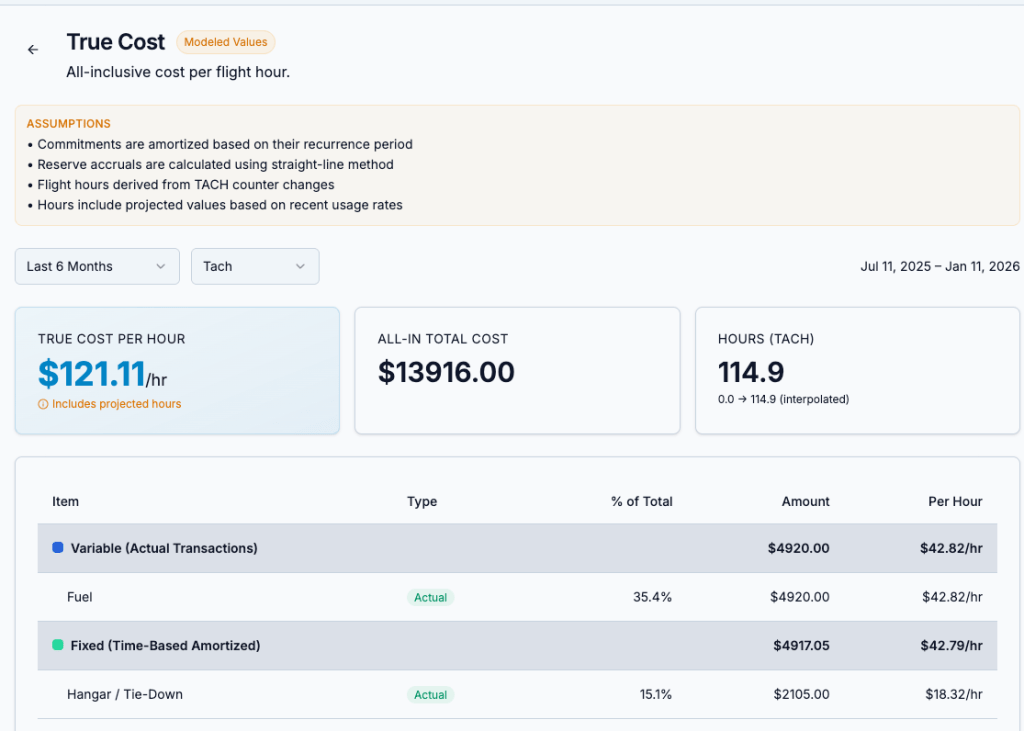
True Cost
Ownership costs aren’t just what you paid last month.
True Cost expands the picture by incorporating reserves and amortized expenses alongside transactions. It answers the more honest question:
What does owning this aircraft really cost, once future obligations are accounted for?
This insight helps avoid the false comfort of low short-term spending by surfacing long-term costs early, while they’re still manageable.
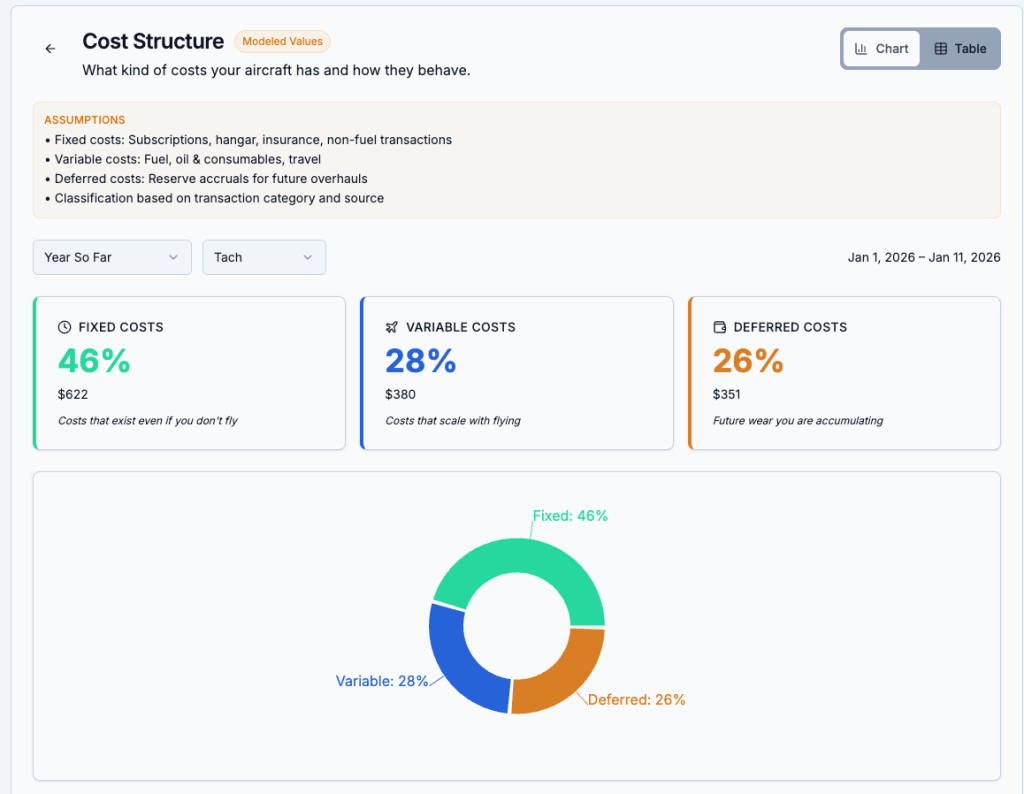
Cost Structure
Not all costs behave the same way.
Cost Structure breaks ownership costs into meaningful categories, typically separating fixed commitments from variable, activity-driven expenses. This makes it easier to understand which costs scale with flying more, and which exist simply because the airplane exists.
It’s the insight that turns raw numbers into intuition.
Outlook
This is where time re-enters the equation.
Outlook looks forward, using commitments, known maintenance patterns, and existing financial data to project upcoming costs. It doesn’t promise certainty—it provides visibility.
The goal isn’t prediction. It’s preparedness.
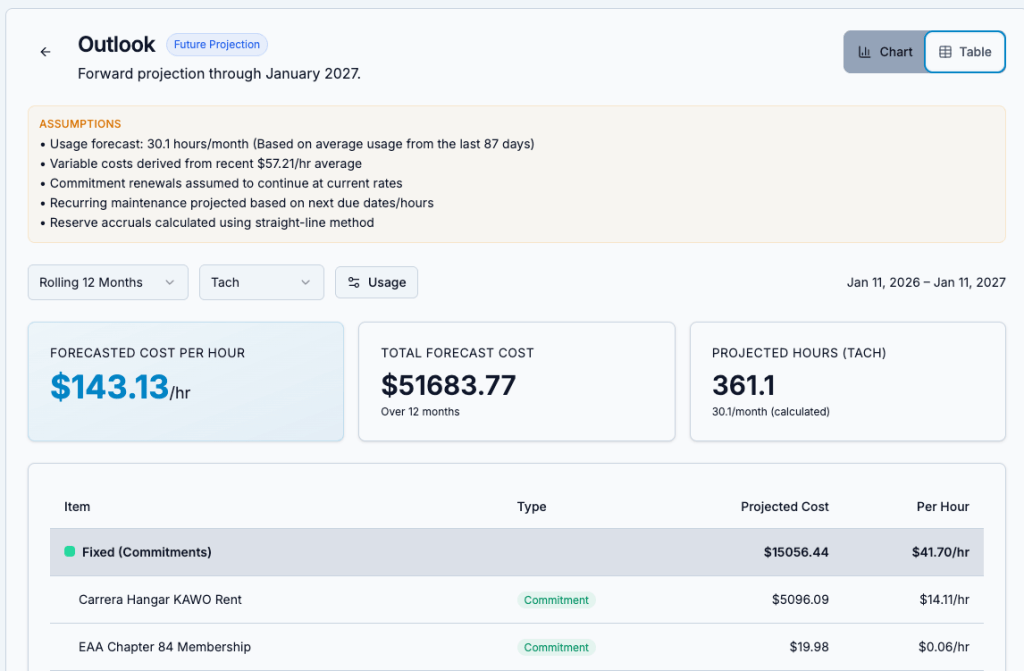
Assumptions
Every financial model rests on assumptions, whether they’re written down or quietly embedded.
Assumptions makes those explicit.
This insight surfaces the inputs and simplifications that shape the other views: time windows, extrapolation rules, reserve logic, and data completeness. By making assumptions visible, Slingology MX gives owners the ability to interpret insights correctly instead of treating them as unquestionable truth.
Transparency beats false precision.

Closing the Loop: From Records to Real Ownership Awareness
Slingology MX didn’t add financial capabilities to become accounting software.
There are already excellent tools for taxes, invoices, and general bookkeeping. That’s not the problem space here. The problem Slingology MX is trying to solve is different—and very specific to aircraft ownership:
How do all the technical decisions, maintenance actions, and recurring obligations translate into real cost over time?
By placing financial records next to maintenance, counters, commitments, and reserves, Slingology MX connects cause and effect. A maintenance task isn’t just a log entry anymore. A recurring service isn’t just a forgotten subscription. Future costs stop being abstract ideas and start becoming visible, intentional parts of ownership.
The result isn’t a single “number.”
It’s situational awareness.
You can see what happened.
You can understand true cost.
You can recognize cost structure.
You can look ahead with an informed outlook.
And—critically—you can see the assumptions behind all of it.
That’s the difference between tracking expenses and understanding ownership.
How to Access Slingology MX
Slingology MX is available to the community today as a free offering, and the financial capabilities described here are now part of the platform.
If you’re already using Slingology MX, these features are available immediately—no migration gymnastics, no separate tool, no parallel spreadsheets required.
If you’re new, you can subscribe the same way outlined in previous Slingology posts:

You can request an early access code here.
For builders and owners who prefer full control, Slingology MX is also available as open source. You can clone the repository, self-host the system, and adapt it to your own workflows. The same data model and concepts apply—whether you run it in the cloud or in your own environment.
That choice is intentional. Slingology MX is designed to be transparent, inspectable, and owner-controlled—just like experimental aviation itself.






 Slingology - Building and Flying a Sling TSi
Leave a comment