
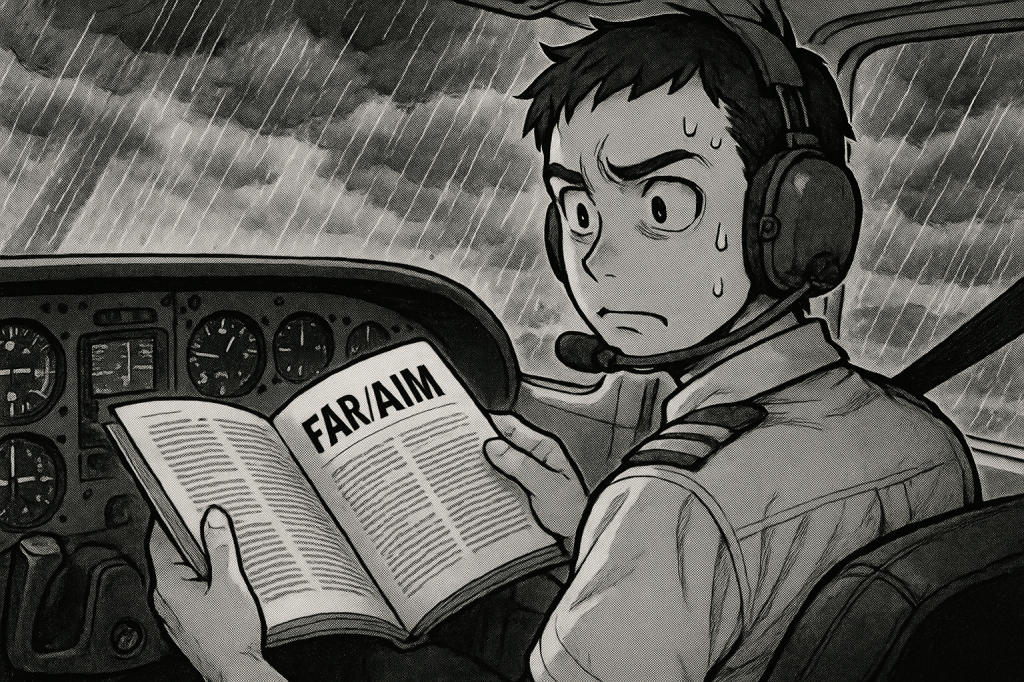
TL;DR: A controller’s reminder about “procedure turn confusion” led me to build a Garmin Pilot IFR Checklist — a compact, quick-reference list of acronyms and rules we all tend to forget once the checkride is behind us. It’s designed for in-flight reference inside Garmin Pilot, covering items like IM SAFE, CRAFT, MARVELOUS VFR C500, SHARP TT, and more. A small effort for a big boost in proficiency.
There’s a funny thing about flying under IFR: the more experience you gain, the less you look at the books — until something weird happens and suddenly you wish you had.
Recently, I was listening to a webinar where an air traffic controller discussed the most common IFR pilot deviations. Besides the obvious ones (altitude busts and heading wander), one stood out — pilots executing a procedure turn (PT) when none is required… or skipping one when it is.
ATC doesn’t love surprises, and that kind of deviation can create serious issues in busy airspace or even unsafe situations. Imagine you turn outbound to fly a hold-in-lieu or PT when everyone else expects you to go straight in. It’s not just awkward — it’s chaos management for the controller.
That comment stuck with me. Because if I’m honest, the time I was most fluent in IFR minutiae — the obscure rules, exceptions, and mental checklists — was right before my instrument checkride. Back then, I could quote you MARVELOUS VFR C500 in my sleep and tell you when SHARP TT applied without hesitation. These days, I have to dig deeper into memory (or scroll through PDFs buried in my EFB).
But in actual flight? When you’re in the soup, managing radios, approach briefings, and your own workload? You don’t have time to go document diving. That’s why I decided to bring the essentials back — this time directly into Garmin Pilot, in checklist form.
If you’d like to use it yourself, simply download the file and import it into Garmin Pilot under the Checklists section. Once imported, it will appear alongside your aircraft procedures, where you can open or edit it anytime.
I’ll keep the file updated and share new versions as I refine it. If you have ideas or favorite mnemonics I missed, let me know — I’d love to include community additions.

Why Build a Garmin Pilot IFR Checklist
Most of us use Garmin Pilot (or ForeFlight) for flight planning, navigation, and approach plates. But Garmin’s Checklist feature is an underrated gem — a place to build your own reference tools, not just aircraft procedures.
So I built one: a compact, quick-reference IFR Knowledge Checklist. It’s not for running the airplane — it’s for running your brain.
It lives in Garmin Pilot alongside my pre-flight, cruise, and approach checklists, ready to pop open when I need a mental refresher. It’s not meant to replace training or official sources, but to jog memory during those “wait, do I need a PT here?” moments.
The Building Blocks
The checklist includes both the regulatory anchors and the mental frameworks that keep IFR flying sharp. Here’s what’s inside:
- Preflight Self-Assessment (IM SAFE)
Illness, Medication, Stress, Alcohol, Fatigue, Emotion. Simple, timeless, and easy to skip. - Risk Management & Personal Minimums (PAVE)
Pilot, Aircraft, enVironment, External pressures — a risk scan before every flight, not just checkride material. - Passenger Briefing (SAFETY)
Seat belts, Air vents, Fire extinguisher, Exit doors, Traffic, Your questions. A solid habit, even in small GA cockpits. - Preflight Information Required (NWKRAFT)
NOTAMs, Weather, Known delays, Runway lengths, Alternatives, Fuel, Takeoff/landing distances — the legal backbone. - Alternate Requirements (1-2-3 Rule)
Need an alternate if within 1 hour before/after ETA, ceiling <2000 ft or vis < 3 miles. - IFR Clearance (CRAFT)
Clearance limit, Route, Altitude, Frequency, Transponder code — the first time you use this on your own is a rite of passage. - Required Reports Under IFR (MARVELOUS VFR C500)
Your memory muscle atrophies fast here. Missed approach, Airspeed change, Reaching a hold fix… it’s a long list. Worth revisiting. - Position Report Content in Non-Radar Environment (A PTA TEN R)
Aircraft ID, Position, Time, Altitude, Type of flight plan, ETA, Next fix, Remarks. Rarely used — but critical when needed. - Lost Communications (MEA AVEF)
Route: Assigned, Vectored, Expected, Filed.
Altitude: Minimum, Expected, Assigned.
It’s the IFR equivalent of a trust fall into procedure. - When Not to Fly a Procedure Turn (SHARP TT)
Straight in, Hold in lieu, ARC, Radar vectors, NoPT, Timed approach, Teardrop course reversal.
The mnemonic that started this whole thing. - Pilot Reports (PIREP)
How to give them, what matters, and why they help the next person behind you.
Reference
Portions of this checklist draw on material from PilotsCafe’s “IFR Quick Review Study Guide” — available for download at pilotscafe.com. It remains one of the most valuable resources I’ve used, both during my instrument training and later for refreshing my IFR knowledge. The guide is free, though the author welcomes voluntary contributions — and it’s well worth supporting.





 Slingology - Building and Flying a Sling TSi
Leave a reply to Jorge Cancel reply