
Every pilot likes to imagine that emergencies are rare and unlikely. In reality, aviation history tells a different story: mechanical issues, weather surprises, and simple bad luck occasionally force pilots to land somewhere other than a runway.
The good news is that most off-airport landings in general aviation are survivable. The bad news is that what happens after the landing can matter just as much as the landing itself.
Search and rescue in the United States is remarkably capable. Between 406 MHz ELTs, ADS-B tracking, satellite messaging, and radar coverage, modern aircraft are far easier to locate than they were even a decade ago. In many cases, help arrives within hours.
Still, hours can turn into a day—or sometimes longer—depending on weather, terrain, and the circumstances of the emergency. That reality led me to design a compact 48-hour emergency kit for my Sling TSi.
Before going further, two important caveats. First, I am not a survival expert. I approached this as a pilot and aircraft owner trying to think carefully about realistic risks and practical preparation. Second, I spent time researching common recommendations for aviation and wilderness emergency kits—from pilot forums, survival guides, and aviation safety resources—to understand what equipment is typically suggested and why.
One way to think about emergency preparedness is as a probability distribution. Some emergency scenarios are relatively common and require simple equipment—bleeding control, protection from exposure, hydration, and signaling. Other scenarios are extremely rare but would require much larger and heavier survival gear. Designing an aircraft emergency kit is therefore an exercise in balancing probability versus complexity, weight, size, and cost.
My goal was to cover the majority of realistic post-landing survival scenarios with the most compact and efficient kit possible.
Rather than building a wilderness survival pack designed to sustain someone for a week in the backcountry, I focused on a more practical objective: create a small kit that helps two people stabilize injuries, manage exposure, maintain minimal hydration, and make it easier for rescuers to find them for roughly 48 hours.
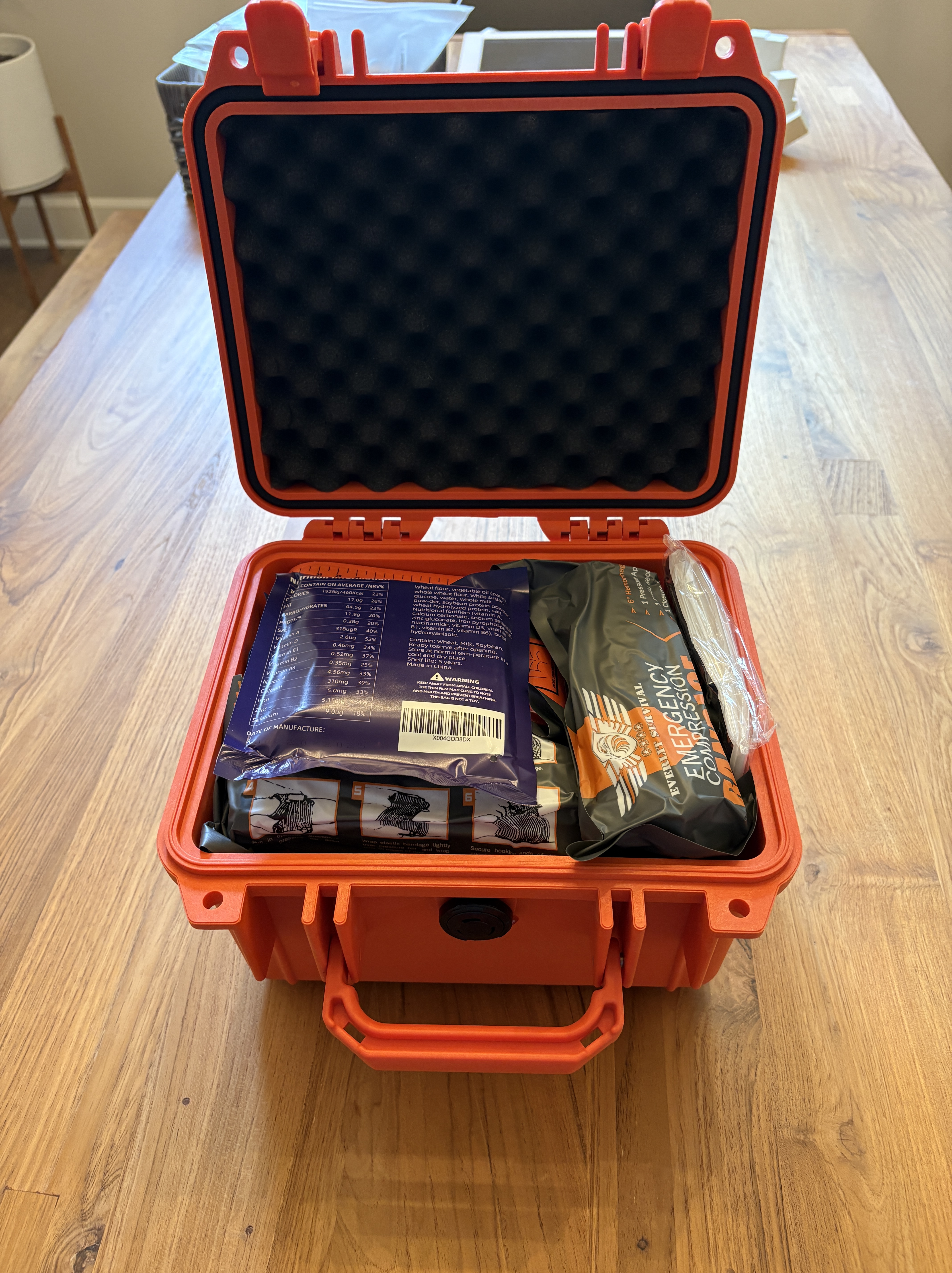
To keep things disciplined, I imposed a strict constraint: everything must fit inside a Pelican 1300 case.

That single decision forces a different kind of thinking. Every item must justify the space it occupies. The result is a compact kit that weighs only a few pounds but addresses the most important risks pilots might face after an emergency landing.
In this post, I’ll walk through the philosophy behind the kit, the equipment I chose, and how it all fits into one small case in the airplane.
Design Philosophy and Constraints
Before selecting any equipment, I wanted to establish a few clear design constraints for the kit. Without constraints, emergency kits have a tendency to grow quickly—more gear, more tools, more “just in case” items—until they become large backpacks that rarely make it into the airplane.
The first constraint was size. Everything had to fit inside a Pelican 1300 case. This case is compact, durable, and easy to secure in the aircraft, but its limited volume forces discipline. Every item must justify the space it occupies.
The second constraint was weight. Although the Sling TSi has generous useful load for its class, any item carried in the airplane should earn its place. An emergency kit that weighs several pounds but addresses the most important risks is acceptable; a heavy survival pack designed for multi-day wilderness living is not.
The third constraint was mission realism. Most of my flying will take place in the United States, including the Pacific Northwest and occasional trips through desert environments. These areas present different environmental challenges—cold and moisture in the mountains, heat and sun exposure in desert regions—but both share an important characteristic: search and rescue infrastructure is generally effective, and aircraft equipped with modern avionics are highly trackable.
Because of this, the kit is designed around a realistic objective: support two people for roughly 48 hours after an off-airport landing. The goal is not to live comfortably in the wilderness. The goal is to stabilize injuries, prevent exposure, maintain minimal hydration, and make it easier for rescuers to locate the aircraft and its occupants.
From these constraints, the equipment naturally fell into a few core categories:
- Trauma and first aid – controlling bleeding and stabilizing injuries
- Exposure protection – preventing hypothermia or heat stress
- Hydration and food – providing minimal sustenance for a short period
- Signaling and visibility – helping rescuers locate the aircraft
With those priorities established, the next step was selecting equipment that provides the greatest practical capability while remaining compact enough to live permanently inside a single Pelican case.

Trauma and First Aid: The Highest Priority
After an off-airport landing, the most immediate risk is not hunger or thirst—it is injury. Even a relatively controlled landing can result in cuts, blunt trauma, or fractures. For that reason, the most important category in the kit focuses on bleeding control and basic injury stabilization.

The trauma portion of the kit includes a SOF tourniquet, QuikClot hemostatic gauze, and an Israeli emergency bandage. Together, these items are designed to control severe bleeding, which is one of the most time-critical medical emergencies. The kit also includes an elastic bandage and a SAM splint, which can help stabilize sprains or fractures until professional medical assistance arrives.
The goal of this section of the kit is not to provide comprehensive medical care. Rather, it is to address the most serious and time-critical problems that might occur immediately after an accident: controlling bleeding and immobilizing injuries long enough for rescue or evacuation.
While this equipment is compact, it is capable of addressing many of the most common trauma scenarios pilots might face after an emergency landing.
Protection from Exposure
After injuries, the next major risk following an emergency landing is exposure to the environment. Even in relatively mild conditions, wind, moisture, and temperature changes can quickly lead to hypothermia or heat stress—especially if occupants are injured or forced to remain outside the aircraft while waiting for rescue.

To address this risk, the kit includes a SOL emergency bivvy, a Mylar thermal blanket, and a lightweight emergency poncho. The bivvy provides the most effective protection, acting as a compact reflective shelter that helps retain body heat and block wind. The Mylar blanket adds additional versatility: it can serve as an extra insulation layer, a ground sheet, or even a reflective signaling surface. The poncho provides protection from rain or sun exposure and can also be used to create a small improvised shelter.
Together, these items provide several layers of protection against both cold and heat while remaining extremely compact. Their purpose is simple: help occupants retain body heat, stay dry, and reduce exposure to the elements while waiting for rescue.
Hydration and Food
While injuries and exposure are the most immediate concerns after an emergency landing, maintaining basic hydration and energy becomes increasingly important as time passes. The kit therefore includes a small amount of water and food designed to sustain two people for a short period while waiting for rescue.

For water, the kit includes several emergency water packets along with a LifeStraw personal water filter. The sealed water packets provide a guaranteed supply of drinking water immediately after an accident, while the filter offers the ability to safely drink from natural water sources if they are available nearby. This combination provides flexibility without requiring the kit to carry large quantities of water.
For food, the kit includes compact emergency ration bars, which are calorie-dense and have a long shelf life. These rations are not intended for comfort or regular meals, but rather to provide enough energy to help maintain strength and alertness during the hours or days following an emergency landing.
The goal of this section of the kit is not long-term survival, but simply to provide basic hydration and caloric support for roughly 48 hours while awaiting assistance.
Signaling and Visibility
Once injuries are stabilized and exposure risks are addressed, the next priority is helping rescuers locate the aircraft and its occupants as quickly as possible. While modern aircraft benefit from technologies such as 406 MHz ELTs, ADS-B tracking, and satellite communication devices, visual signaling can still play an important role in helping search teams quickly identify the exact location of a downed aircraft.

For this reason, the kit includes several simple signaling tools: a signal mirror, a high-visibility signal panel, and a safety whistle. These items are lightweight, inexpensive, and extremely compact, yet they can be very effective in attracting attention once rescuers are operating in the vicinity.
A signal mirror can reflect sunlight over long distances and is a traditional tool used in survival situations to attract attention from aircraft. The whistle provides an easy way to generate loud, repeated sound signals without exhausting the user. The signal panel, made of bright high-visibility material, can be deployed on the ground to increase contrast with the surrounding terrain and help search crews visually identify the location from the air.
A waterproof USB plasma lighter provides a reliable way to start a fire if needed. While fire is not always necessary in a short-term survival situation, it can provide warmth, help dry wet clothing, or create additional signaling capability through smoke.
These tools require very little space in the kit but significantly improve the chances of being spotted quickly once rescuers are nearby.
Equipment Carried Outside the Kit
While the Pelican case contains the core emergency supplies, a few items are intentionally kept in the cockpit rather than inside the kit. These are tools that may be needed immediately after an accident and should therefore be accessible without opening the case.
For this reason, I added a window breaker and seatbelt cutter tool to the cockpit. This type of tool is commonly recommended for vehicles and aircraft because it allows occupants to quickly cut through a jammed seatbelt or break a side window if the door cannot be opened.
Other commonly used items, such as a headlamp, multitool, or communication devices, are also typically carried on the pilot or readily accessible in the cockpit rather than stored inside the emergency kit. In an emergency situation, these tools may be needed immediately, and keeping them within reach improves the chances they can be used effectively.
The Pelican case therefore serves as the central survival kit, while a few critical tools remain positioned in the cockpit where they can be accessed quickly if needed.
Final Kit Summary
Bringing all of these elements together, the Pelican 1300 case contains equipment organized around four primary priorities:
Trauma and First Aid
- SOF tourniquet
- QuikClot hemostatic gauze
- Israeli emergency bandage
- ACE elastic bandage
- SAM splint
Protection from Exposure
- SOL emergency bivvy
- Mylar thermal blanket
- Emergency survival poncho
Hydration and Food
- Datrex emergency water packets
- LifeStraw personal water filter
- Emergency ration bars
Signaling and Visibility
- Signal mirror
- Survival whistle
- Signal panel
Together, these items provide a compact but capable emergency kit designed to support two occupants for approximately 48 hours after an off-airport landing while waiting for rescue.
Final Thoughts
Emergency preparedness in aviation is ultimately about managing risk. While the likelihood of needing an emergency kit is low, the potential consequences of being unprepared can be significant.
The kit described here is intentionally simple and compact. By focusing on the most likely needs—injury management, exposure protection, hydration, and signaling—it provides meaningful capability without adding excessive weight or complexity to the airplane.
The entire kit, including the Pelican case and all contents, weighs approximately 7.3 pounds, and the total cost was roughly $300, with all items purchased from Amazon. For a relatively modest investment in both weight and cost, the kit provides equipment that could make a meaningful difference in the unlikely event of an emergency landing.
Most importantly, the kit is small enough that it can live permanently in the aircraft, ensuring that it is available whenever it might be needed.
Hopefully this example provides a useful starting point for other pilots thinking about how to assemble their own emergency kit.
References on Aviation Emergency Kits
Before assembling the kit, I reviewed several aviation and survival resources that discuss recommended equipment and post-crash survival priorities. A few useful examples are listed below.
FAA – General Aviation Survival Guide
The FAA’s survival guide explains the fundamentals of post-crash survival and recommends tailoring survival equipment to the terrain, climate, and type of flying you do.
https://www.faa.gov/sites/faa.gov/files/2022-01/General%20Aviation%20Survival.pdf
FAA – CAMI Survival Manual
A training manual from the FAA’s Civil Aerospace Medical Institute describing survival priorities after an aircraft accident and typical components of aviation survival kits.
https://www.faa.gov/pilots/training/airman_education/media/CAMISurvivalManual.pdf
AOPA – Survival Skills for Pilots
AOPA safety guidance recommending that pilots carry basic survival gear such as first aid supplies, signaling equipment, water, food, and simple tools.
https://www.aopa.org/news-and-media/all-news/2024/october/22/training-and-safety-tip-survival-skills
AVweb – Airplane Emergency Kits
An overview of emergency preparedness for pilots emphasizing the four basic survival needs: shelter, water, food, and signaling equipment.
https://avweb.com/affiliate-content/airplane-emergency-kits/
FAA Pilot Minute – Essential Items for a Pilot Survival Kit (Video)
A short FAA video highlighting the basic categories of equipment pilots should consider carrying in their aircraft.
https://www.youtube.com/watch?v=os2AhXNd_gE




Leave a Reply