
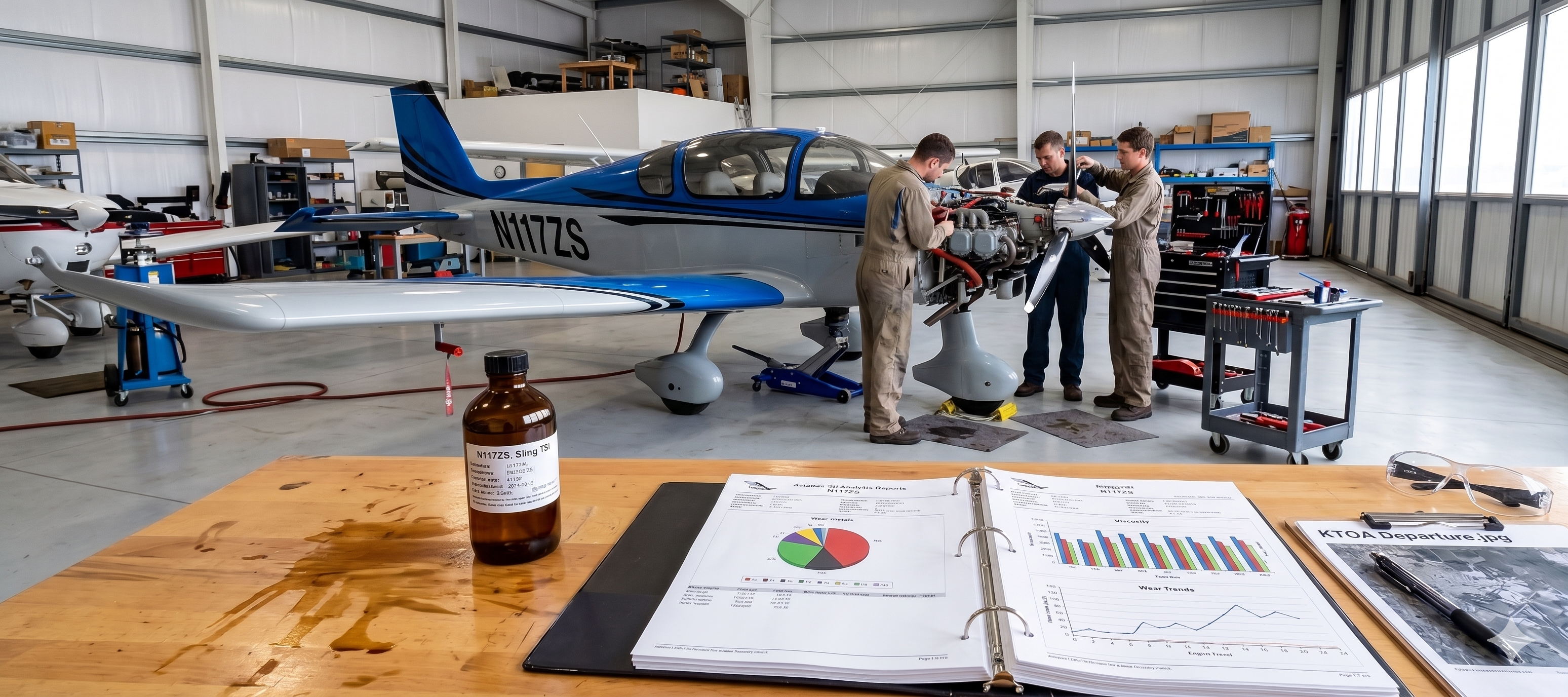
Roci about to hit 75 hours — the first regular oil change since the break-in inspection at 25. The engine has been running well: oil temps in range, pressures solid, no surprises on the G3X. By every visible measure, things are fine. But “looks fine” isn’t a monitoring program. So alongside the standard 50-hour checklist, there’s one addition this time: a small bottle of warm oil heading to a lab in Indiana.
That’s what this post is about — not the oil change itself, but the practice of oil analysis, why it matters on a Rotax 916 iS specifically, and how to start doing it correctly.
Why Oil Analysis, and Why Now
Engine oil does more than lubricate. As it circulates through the engine, it picks up microscopic wear particles shed by every surface it contacts — bearings, gears, cylinder walls, piston rings. These particles are too small to be caught by the oil filter, typically under five microns in diameter, but they accumulate in the oil in measurable concentrations. Spectrographic oil analysis reads those concentrations and reports them in parts per million. The result is a quantitative picture of what the engine is shedding — and by extension, what’s happening inside.
The case for starting at the first routine oil change is straightforward. A first sample on a new, known-good engine establishes a personal baseline — the normal wear signature for this specific engine at this stage of its life. Every subsequent sample is compared against it. Without that baseline, an elevated reading at 200 hours is ambiguous: it could be normal for this engine, or it could represent a meaningful change. With it, the trend is visible and the ambiguity disappears.
This is condition-based monitoring in practice. The 916 iS has a published TBO of 2,000 hours, but on an experimental amateur-built aircraft there is no regulatory requirement to overhaul at TBO. The engine can be operated on condition indefinitely — provided the owner can demonstrate continued airworthiness. Oil analysis, run consistently at every oil change, is one of the primary tools that makes condition-based operation defensible rather than merely hopeful.
The cost of entry is low. A Blackstone standard analysis runs $40, the kit is free, and the sample takes five minutes to pull during an oil change that’s already happening. The marginal effort is negligible. The alternative — flying without trend data until something announces itself more dramatically — is a much worse trade.
What Oil Analysis Actually Is
Oil analysis is spectrographic elemental analysis — a lab technique borrowed from industrial and turbine engine maintenance that has been standard practice in commercial aviation for decades. Its adoption in general aviation piston engines is more recent, driven largely by the condition-based maintenance philosophy that Mike Busch and Savvy Aviation have spent years advocating. The underlying science is straightforward.
A sample of used oil — typically two to three ounces pulled mid-drain while the oil is still warm — is introduced into a plasma arc or inductively coupled plasma (ICP) torch. The extreme heat vaporizes the oil and excites the atoms of every element present. Each element emits light at a characteristic wavelength as its electrons return to ground state. A spectrometer reads those wavelengths and translates them into concentrations, reported in parts per million (ppm). The result is a precise quantitative inventory of every metal present in the oil at the time of sampling.
A standard Blackstone aviation report covers four categories of measurement:
Wear metals — the primary diagnostic data. Each element points to specific engine components. Iron comes from cylinder walls, camshafts, gears, and piston rings. Aluminum from pistons and bearings. Chromium from rings and valve stems. Copper from bearings and thrust washers. Silicon — while not a wear metal — indicates airborne dirt ingestion past the air filter, or silicone sealants. Lead, in a leaded-fuel engine, reflects combustion byproduct accumulation and can indicate blow-by when elevated.
Viscosity — confirms the oil is still within its rated grade range. Significant thinning suggests fuel dilution; thickening indicates oxidation or contamination.
Insolubles — the total concentration of solid particles suspended in the oil, including combustion byproducts and oxidized oil. Elevated insolubles indicate the oil is degrading faster than expected for the interval.
Flashpoint — the temperature at which the oil vapor ignites. A depressed flashpoint indicates fuel contamination in the sump, which thins the oil and compromises its lubricating film.
Every Blackstone report includes not just the raw numbers but a written commentary from a technician — a plain-English assessment of what the readings mean in context. That diagnostic layer is what separates a useful report from a spreadsheet of numbers. It’s also the primary reason Savvy Aviation specifies Blackstone exclusively for its clients, directing that every oil analysis report be attached to the client’s Savvy ticket for review alongside engine monitor data.
Source: Blackstone Laboratories report methodology · iRMT community data via ROTAX-OWNER.com · Rotax 916 iS Line Maintenance Manual
Oil analysis and filter inspection are not the same thing — they’re complementary tools with different diagnostic windows. The oil filter captures particles larger than roughly 20 microns: visible metal, identifiable under magnification, indicative of acute or accelerating wear. Spectrographic analysis captures particles smaller than five microns — the chronic, low-level wear that never produces visible filter debris but accumulates measurably in the oil over time. Running both at every oil change gives the most complete picture. Skipping either leaves a gap.
What’s Different About the Rotax 916 iS
Most of the oil analysis literature — and most of the expertise at general aviation labs — is built around Lycoming and Continental engines. Those engines dominate the piston GA fleet, and labs like Blackstone have decades of data establishing what normal looks like for an O-360, an IO-540, or a TSIO-520. The Rotax 916 iS is a fundamentally different machine, and sending a sample without flagging that difference will produce a report written against the wrong reference frame. There are three things every lab needs to know before interpreting a 916 iS sample.
Nikasil cylinders — tell the lab
The 916 iS uses Nikasil cylinder liners — a nickel-silicon carbide composite coating applied directly to the aluminum cylinder bore rather than a traditional cast-iron sleeve. It is extremely hard, highly wear-resistant, and the reason Rotax cylinders cannot be honed with standard equipment. It is also the reason nickel will appear in the oil analysis report.
On the Blackstone sample submission form, the cylinder type field should be filled in as nickel. On a new or low-time engine, elevated nickel in the first sample is expected — it reflects the cylinders establishing their working clearances during break-in. A lab without Rotax experience will flag elevated nickel as a warning. It is not. It is a normal Nikasil break-in signature that diminishes as hours accumulate. This is confirmed by iRMT technicians across multiple threads at ROTAX-OWNER.com, the primary Rotax owner and technician community.
Integrated gearbox and dog hub — iron runs higher
Unlike Lycoming and Continental engines, the 916 iS has an integrated propeller speed reduction gearbox driven through a torsional dampener — a dog hub and dog gear assembly that absorbs shock loads between the crankshaft and propeller. These are metal-to-metal contact surfaces, and they shed iron into the shared oil system as a matter of normal operation. The iron reading in a typical Rotax sample will be higher than what a Lycoming or Continental of comparable hours would produce.
The Rotax-owner community at ROTAX-OWNER.com, drawing on iRMT technician experience, puts a typical iron reading for a 100-hour sample at around 20 mg/kg. A lab calibrated to Lycoming/Continental norms will treat that number as elevated. For a Rotax, it is baseline. What matters is not the absolute number but the trend: a consistently elevated iron reading that holds flat across multiple samples is normal. One that increases materially from sample to sample warrants investigation.
XPS 5W-50 — different rules than traditional GA oil guidance
The 916 iS runs Rotax XPS 5W-50 Full Synthetic — a manufacturer-mandated oil developed specifically for this engine family over two years of testing, including more than 40 formulated variations and 20,000 gallons of aviation fuel validation. Per the 916 iS Line Maintenance Manual (Chapter 00-00-00), all oil specifications defer to SI-916 i-001. That Service Instruction explicitly approves XPS for use with both MOGAS and 100LL AVGAS.
This matters for oil analysis context because the traditional GA oil guidance — including Savvy’s published recommendations — warns against full synthetic oils in leaded-fuel engines. That guidance is grounded in the history of PAO-based synthetics, particularly Mobil AV-1, which failed to suspend lead salts from 100LL in solution, causing precipitate buildup that damaged engines. The XPS formulation solved that problem with a purpose-built additive package. It is not subject to the same limitations, and Savvy’s general caution does not apply to a 916 iS running manufacturer-specified oil.
When submitting a sample from the 916 iS, note the oil type as XPS 5W-50 Full Synthetic. A lab receiving a synthetic oil sample from a leaded-fuel engine without that context may draw incorrect conclusions about oil degradation or lead handling.
Choosing a Lab
Oil analysis is only as useful as the lab interpreting it. The raw numbers — iron at 18 ppm, nickel at 12 ppm, aluminum at 6 ppm — mean nothing without context: what’s normal for this engine type, what’s changed since the last sample, and what the trend suggests about component condition. That interpretive layer is where labs differ significantly, and it’s the primary basis for choosing one over another.
Three labs are worth knowing about for GA piston engine oil analysis in the US.
Blackstone Laboratories
Blackstone Laboratories (Fort Wayne, Indiana) has been in the aviation oil analysis business since 1985, when it acquired the client list and historical database from EOA (Engine Oil Analysis), extending its aviation dataset back decades. A standard analysis runs $40; sample kits are free and include a prepaid return label. The report covers spectrographic wear metals, viscosity, insolubles, and flashpoint — the full diagnostic suite. What distinguishes Blackstone is the written commentary included with every report: a plain-English assessment authored by a technician, not generated by software, that contextualizes the numbers against the engine type and sample history. Blackstone also handles leaded-fuel aircraft samples separately from automotive samples to prevent cross-contamination from high lead counts — a procedural detail that matters for a 100LL engine.
Savvy Aviation specifies Blackstone exclusively for all its clients, directing that reports be attached to the client’s Savvy ticket for review alongside engine monitor data. Mike Busch has cited Blackstone’s quick turnaround, readable report format, and aircraft engine expertise as the reasons for that preference. For a Savvy subscriber, Blackstone is the only practical choice — the workflow is built around it.
Aviation Laboratories / AvLab
Aviation Laboratories / AvLab (Kenner, Louisiana) was founded in 1985 and originally built around the Garrett S.O.A.P (Spectrometric Oil Analysis Program) — the turbine engine oil analysis methodology developed for military and commercial aviation. AvLab uses ICP spectroscopy and covers 12 wear metal elements, with 24–48 hour turnaround and immediate notification on abnormal results. Results are posted online for longitudinal tracking. Aviation Consumer has rated AvLab second behind Blackstone for report quality, aircraft engine expertise, and response time. AvLab does not include viscosity, insolubles, or flashpoint in its standard analysis — a meaningful gap compared to Blackstone’s full suite.
ALS Tribology / ALS Global
ALS Tribology / ALS Global is an industrial laboratory with an aviation division. It is not aviation-specific in the way Blackstone or AvLab are, but community members report analytical results within 5% of AvLab’s on side-by-side comparisons, prices roughly 40% lower, and turnaround of approximately one week from shipping. For owners who prioritize cost and turnaround over aviation-specific commentary, it is a credible option. It is not Savvy-integrated.
The Rotax problem with all three
None of these labs has a meaningful Rotax 916 iS fleet database. The 916 iS was publicly introduced in 2023 and the installed base is small. Blackstone’s universal averages and unit averages — the comparative reference points printed on every report — are built predominantly on Lycoming and Continental engine data. AvLab’s interpretive guidelines have the same limitation.
This is not a reason to skip oil analysis. It is a reason to approach the first several reports with calibrated expectations, and to provide the lab with as much context as possible about the engine architecture. The iRMT community at ROTAX-OWNER.com is explicit on this point: labs without Rotax experience will flag iron and nickel readings that are normal for this engine. Flagging the engine as a Rotax 916 iS, noting Nikasil cylinders, and noting the integrated gearbox on the submission form gives the analyst the context needed to avoid misinterpretation.
The Wearcheck network — a global industrial tribology lab — is sometimes cited in the Rotax community as having a more extensive Rotax-specific database, drawing on a larger international installed base of 912 and 914 engines. It is worth noting for completeness, though it lacks the aviation-specific focus and Savvy integration that make Blackstone the practical choice for most US-based experimental owners.
| Criterion | Blackstone Labs Our Pick | AvLab | ALS Tribology |
|---|---|---|---|
| Location | Fort Wayne, IN | Houston, TX | Multiple US labs |
| Standard Price | $40 | $22.95 + postage | ~$20–28 |
| Kit Cost | Free, prepaid return | Prepaid options available | Kit fee applies |
| Turnaround | 3–7 days from receipt | 24–48 hrs from receipt | ~1 week from ship |
| Wear Metals | Full suite | 12 elements (ICP) | Full suite (ICP) |
| Viscosity | Included | Not included | Included |
| Insolubles | Included | Not included | Varies |
| Flashpoint | Included | Not included | Varies |
| Written Commentary | Human-written, every report | Automated + alerts | Automated + ranges |
| Aviation Focus | Aviation-specific | Aviation-specific | Industrial / general |
| Savvy Integration | Required by Savvy | Not integrated | Not integrated |
| Rotax 916 iS Data | Limited — new engine | Limited — new engine | Limited — new engine |
| 100LL Handling | Separate batch run | Aviation-aware | Standard protocol |
Provide engine model, cylinder type (nickel), oil type (XPS 5W-50), and fuel type (100LL) on every submission form.
Prices current as of 2025 · blackstone-labs.com · avlab.com · alsglobal.com
The Process
Oil analysis adds five minutes to an oil change that’s already happening. The procedure is straightforward, but a few details matter — specifically when the sample is pulled, how it’s captured, and what goes on the submission form.
Getting the kit
Blackstone sample kits are free. Order them at blackstone-labs.com — a box of several arrives in the mail within a few days, each containing a small sample bottle, a submission form, and a prepaid return envelope. Keep a few on hand. The kit needs to be ready before the oil change begins, not improvised afterward.
Warming the engine first
The sample must be pulled from warm oil. A cold engine oil sample is unrepresentative — wear particles and combustion byproducts settle and stratify as the oil cools and sits. The standard practice is to fly the aircraft normally, then pull the sample immediately after shutdown while the oil is still at full operating temperature. On the 916 iS, the turbocharger cool-down period is a required step before shutdown regardless — so the sample pull fits naturally into the post-flight workflow after the cool-down run is complete.
Pulling the sample mid-drain
The sample is pulled during the oil drain, not before and not after. Let the first few seconds of flow pass — the initial surge can carry sediment that has settled at the bottom of the sump and is not representative of what was circulating. Then capture two to three ounces of mid-drain oil directly into the Blackstone sample bottle. Do not fill from a drain pan. Do not use a vacuum pump extraction method from the dipstick tube unless the drain is not accessible — mid-drain from the sump drain valve is the most representative sample. The last portion of the drain can also be skewed by concentrated sediment. The middle of the drain is what the lab needs.
Filling out the submission form correctly
This is where Rotax-specific context gets documented. The form asks for:
- Engine make and model: Rotax 916 iS
- Cylinder type: Nickel (Nikasil coating — this is the field that prevents the lab from misinterpreting elevated nickel as an alarm condition)
- Oil type: XPS 5W-50 Full Synthetic
- Hours on the oil: hours since last oil change
- Total engine hours: total time since new
- Fuel type: AVGAS 100LL
Every field matters. Hours on oil affects viscosity and insolubles interpretation. Total engine hours contextualizes wear metal levels against engine age. Cylinder type and oil type are the two Rotax-specific entries that most directly affect how the analyst frames the commentary.
For Savvy subscribers, the completed Blackstone report is uploaded directly to the client’s Savvy ticket once received. Savvy’s A&P analysts review it alongside engine monitor data — EGT trends, CHT trends, oil temperature and pressure history — as part of the broader engine health picture. The oil analysis report does not stand alone in that workflow; it is one input among several.
Shipping
A small container of used oil is not classified as hazmat for shipping purposes. Drop the sealed sample bottle into the prepaid Blackstone envelope and put it in any USPS mailbox. Blackstone processes samples and emails the report as a PDF, typically within a few days of receipt.
What the First Report Will and Won’t Tell You
The first oil analysis report from a new engine is not a diagnostic verdict. It is the opening entry in a longitudinal record — useful primarily as a reference point against which every subsequent sample will be compared. Understanding what to expect from that first report, and what it cannot yet tell you, is part of using the tool correctly.
What to expect on a low-time engine
A new engine is still establishing working clearances across all its contact surfaces. Wear rates in the first 50 to 100 hours are higher than they will be at steady state, and the oil analysis report will reflect that. On a 916 iS, two elements in particular will likely read higher on the first sample than on subsequent ones:
Nickel — from the Nikasil cylinder liners establishing their bore geometry. The iRMT community at ROTAX-OWNER.com has documented this pattern across multiple Rotax first samples: elevated nickel on a new engine is a normal break-in signature, not a warning condition. It reflects the cylinder coating establishing its working surface, and it should trend downward as hours accumulate. When submitting the sample, noting “Nikasil cylinders” in the comments gives the Blackstone analyst the context to interpret this correctly rather than flagging it as an anomaly.
Iron — from the gearset, dog hub, cams, tappets, and piston rings, all of which are also establishing their working surfaces. As noted above, iron runs structurally higher in Rotax engines than in Lycoming or Continental engines of comparable hours due to the integrated gearbox architecture. On the first sample it may read higher still. The iRMT community puts a typical 100-hour steady-state iron reading around 20 mg/kg (ROTAX-OWNER.com); the first 50-hour sample may exceed that as surfaces settle in. A reading that holds flat or decreases on subsequent samples is not a concern. One that increases materially from sample to sample warrants follow-up.
What the report cannot yet tell you
A single sample has no trend. Mike Busch addressed this directly in his Savvy Aviator column on oil analysis: “you really can’t tell anything from one or two oil analysis reports; it’s a trend-monitoring tool, and you need to give it time to establish a trend before you can derive useful information from it.” He illustrated the point with a real case where elevated wear metals on a sample were only significant because they were materially higher than the previous three or four samples from the same engine — numbers that would have appeared unremarkable on a first sample with no history behind them.
That is the fundamental limitation of first-sample analysis, and it applies regardless of engine type, lab, or oil. The first report establishes the baseline. The value accumulates with every subsequent sample that follows.
For Savvy subscribers, the workflow is straightforward: attach the Blackstone report to the client ticket, where Savvy’s A&P analysts review it alongside engine monitor data — EGT trends, CHT trends, oil temperature and pressure history. The oil analysis is one input in a broader picture, not a standalone verdict.
What would actually warrant attention
Even on a first sample, certain readings would be genuinely concerning regardless of break-in context. Blackstone’s published report explanation identifies the key signals: very high aluminum suggesting piston or bearing distress; elevated silicon indicating dirt ingestion past the air filter; a depressed flashpoint indicating fuel contamination in the sump; significantly elevated copper pointing to bearing wear. These are not normal break-in signatures. They indicate something other than normal surface establishment is occurring and warrant follow-up — whether a borescope inspection, an oil filter cut-open and examination, or a shorter-interval resampling before the next scheduled oil change.
The follow-up
This post establishes the framework. A follow-up post will cover the actual results from Roci’s first sample — what the numbers were, how they compared to expected break-in signatures, and what the Blackstone commentary said. As hours accumulate and samples build into a longitudinal record, that data will also feed into broader engine log analysis. The trend, not the snapshot, is the story.



Leave a Reply