
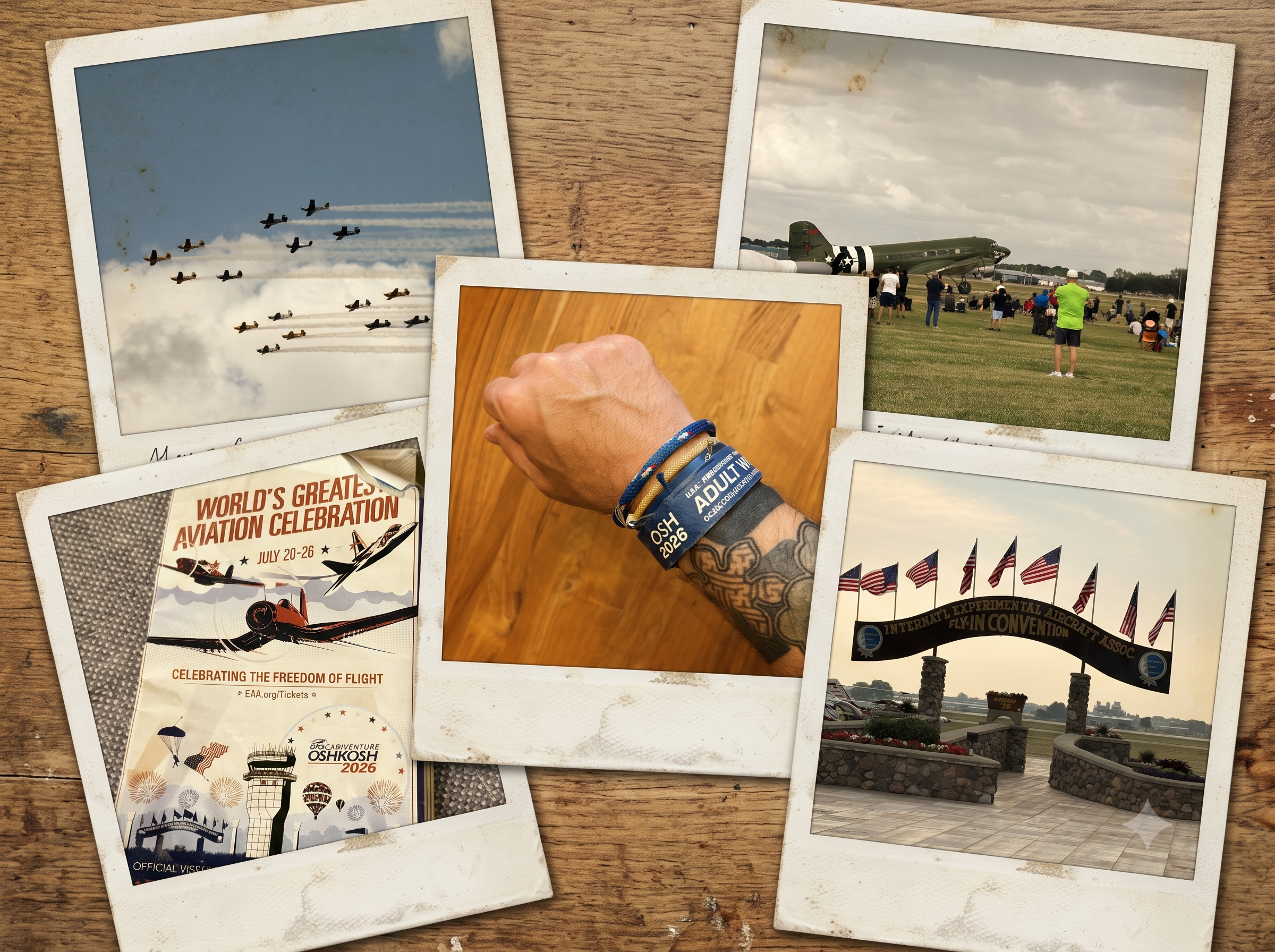
Sometime in November 25, months before Roci’s build was even complete, I booked a dorm room at the University of Wisconsin Oshkosh campus and paid for the week pass. Oshkosh dorm bookings open early and go fast, and if you wait until you’re sure you’re going, you’re not going. So I paid for a room in a building I’d never seen, for a week that summer, in an airplane that didn’t exist yet outside a set of assemblies and a build log.
It wasn’t confidence. It was closer to a bet against my own hesitation — the kind of commitment you make specifically so that a later, more anxious version of yourself has one fewer excuse to back out.
That’s really where this story starts. Not at 4:30 in the morning on departure day, not over the Cascades, not on the Fisk arrival. It starts with a credit card transaction in November, made on the assumption that an airplane that didn’t yet exist would be finished, tested, and ready to fly across the country by July.

Between November and July, Roci got finished, inspected, and flown. The trip stopped being a bet and started being a plan.
A few days before departure, I set up the simulator and ran the Fisk arrival for the first time — the reporting points, the altitude and airspeed blocks, the choreography of a dozen airplanes converging on one road at 90 knots with no radio calls. I’d read about it for months. Running it in the sim was the first moment it stopped being a procedure I understood and started being a procedure I’d have to actually fly, at pattern altitude, in a line of strangers, with no do-overs.

Four-thirty in the morning at KAWO, the ramp is dark and quiet, but the hangar lights are on — no headlamps needed, just the ordinary fluorescent hum of preflighting inside four walls while the rest of the airport sleeps. Matt Keefe, my companion for this trip, was already loading his bag as I finished the checks.
KAWO has no tower and no clearance delivery on frequency, so getting an IFR clearance means taxiing to the runup area and calling it in from there — sitting in the dark at the end of the runway, engine running, waiting. That morning the wait was just a few minutes, the clearance delivery was not busy. A few minutes of sitting still, ready to go, with nothing to do but wait for a stranger on a phone line to read a clearance before the day could actually begin.
The Cascades were under an overcast deck that morning, which meant the first twenty minutes of the trip happened entirely on instruments — hand-flying the climb through gray, the GTN feeding course guidance, watching the peaks I couldn’t see tick by underneath on the terrain page. Somewhere above 10,000 feet the gray started thinning, then breaking, and then Roci came out on top into clear air with the sun just starting to come up over the tops of the clouds, mountains still buried underneath.

That was the moment the trip actually started. Not the takeoff, not the minutes idling in the runup area, not the dorm room booked back in November — this. Dark ramp, a clearance wait, a hand-flown climb through cloud, and then daylight arriving from the east while the airplane that didn’t exist a year ago carried me over a mountain range I couldn’t see, toward an airport I’d been dreaming about since long before I owned anything that could fly there.

During the the show, EAA runs rides in a Ford Tri-Motor — a genuine 1928 airplane, corrugated aluminum skin, three engines, a cabin you climb into rather than sit in. I paid for a seat and rode it over the same airport Roci was parked at.
From altitude, the field looked the way it must have looked to whoever was flying tri-motors like this one when Oshkosh wasn’t yet a pilgrimage — just farmland, a runway, airplanes coming and going. The Tri-Motor climbs the way you’d expect something built in 1928 to climb: unhurried, loud, three engines working audibly for every foot of altitude. Nothing about it is efficient by any modern measure. It doesn’t need to be. It’s still flying, ninety-eight years later, doing the same job it was built to do.

Roci was on the ground somewhere below — aluminum too, in the end, like the Tri-Motor above it, but wearing a Rotax 916 iS and a glass panel instead of three round engines and steam gauges. Different century, same material, same impulse. Sitting in a bucket seat in a 1928 airliner looking down at a 2026 amateur-built, it was hard not to think about how much has changed in the how, and how little has changed in the why.
Industry Trends
MOSAIC Phase 2
MOSAIC’s Phase 2 took effect July 24 and its real significance isn’t regulatory, it’s economic. For years, the LSA weight cap forced a trade every manufacturer had to make: build light enough to qualify, and give up useful load, IFR capability, or both. MOSAIC removes that ceiling, letting manufacturers build airplanes at higher gross weights, with real IFR equipment, without stepping into the cost and multi-year burden of a full Part 23 type certificate.
Here’s the thesis: this is the first structural change in decades that attacks GA’s actual problem, which isn’t a shortage of people who want to fly, it’s the cost of the airplane they’d have to fly in. LSA was supposed to be the affordable alternative to a Part 23 trainer, but the weight cap made it structurally unable to do the job — the moment you add fuel, an instructor, and a student of average size, you’re out of useful load. MOSAIC closes that gap, and Sling is the sharpest proof it isn’t theoretical.

They announced the Sling 2M the same day MOSAIC took effect — a MOSAIC-compliant trainer built around a 1,540 lb gross weight, full IFR capability, and Garmin’s new AXIS flight system. Useful load is over 600 lb: enough for two large adults, a ballistic chute, and eight-plus hours of fuel, without the payload-versus-range trade that’s defined LSA trainers since the category existed. Sling’s current LSA starts at $275,820 with $312,00 for the IFR equipped version; that lands well under a comparable Part 23 trainer. They’re backing that bet with a leasing and financing program aimed at flight schools, and a multi-engine airplane already in development — twin Rotax 916 iS engines, targeted for AirVenture 2027.

Sling wasn’t alone, and the pattern is the same: use MOSAIC headroom to build something that actually competes with certified trainers rather than a compromised LSA. Pipistrel’s Voyager launched with day/night IFR, Garmin AXIS, and a three-axis autopilot, and picked up an order for up to 50 aircraft from Epic Flight Academy — a school currently flying certified Skyhawks, choosing to move its future fleet to a MOSAIC airplane instead. Zenith brought its CH 750 Super Cruzer. CubCrafters brought the turbine-powered Carbon Cub ULT, going the other direction entirely — using MOSAIC headroom not for a docile trainer but for a backcountry airplane with a turbine engine, which nobody could have certified as an LSA a year ago. Four manufacturers, four different bets on what MOSAIC headroom is for, all landing at the same show in the same week.
The downstream effects are the ones worth watching. Lower certification cost means more manufacturers can credibly compete for trainer-fleet business than at any point in decades, at a moment when the industry is forecasting a need for roughly 674,000 new pilots globally over the next twenty years. Fleet economics, not instructor supply or student demand, is the actual bottleneck. For legacy manufacturers, this is a genuine competitive threat, not a curiosity — and it’s telling that Cirrus and Textron that the old playbook will not be applicable in this category anymore. The real fight from here isn’t MOSAIC versus legacy. It’s which manufacturer builds the best MOSAIC airplane first and locks in the next generation of flight schools before anyone else does.
Rotax
If MOSAIC is about what’s now legally possible to build, the Rotax story this year is about what established manufacturers are now choosing to build around — a more interesting signal, because nobody made them do it.
For years, the argument for Rotax over legacy Continental and Lycoming powerplants was mostly made by people like me — E-AB builders and Rotax operators pointing at fuel burn, TBO, FADEC, and multi-fuel capability, while the training and legacy-owner world stayed loyal to engines whose core architecture hasn’t meaningfully changed in half a century. This year, that argument stopped being a homebuilder’s opinion and became two of the most legacy-anchored names in GA training publicly agreeing with it.
Cirrus — a company whose entire trainer lineup has been built around Lycoming and Continental — announced the TRAC10, a clean-sheet three-seat trainer built around a turbocharged Rotax 916 iSc. 160 hp, roughly 5.9 gph at 65% cruise power, multi-fuel capable across 100LL, unleaded 91/94, and mogas blends. Over 100 orders from 13 flight schools already, base price $499,900, deliveries starting 2027. Cirrus didn’t retire its Lycoming/Continental-powered trainers to do this — the SR20/22/22T remain in production alongside it, built specifically because the trainer mission wanted a different engine than the rest of the lineup.

Textron did something similar with Pipistrel’s Voyager, powered by a Rotax 912 ULS. Textron’s own leadership was explicit about why: they wanted a MOSAIC-capable aircraft to market fast, and Pipistrel’s Rotax-based platform let them do that without waiting on a clean-sheet program of their own. Epic Flight Academy — a legacy Skyhawk operator — signed on as launch customer for up to 50 aircraft, choosing to move its future fleet to a Rotax-powered platform.
That’s the real proof point, and it’s a better one than “Rotax is popular in homebuilts.” Two of the most legacy-anchored companies in GA training — one carrying Lycoming/Continental DNA, one carrying Cessna/Skyhawk DNA — both chose Rotax for their clean-sheet MOSAIC answer instead of sticking with the powerplants their whole brand history was built on. That’s the establishment voting with its own new-product decisions.
Where this goes next is the part I’ll admit is just a hope, not a prediction: right now Rotax tops out around 160 hp with the 916 iS. Nothing I’ve seen suggests a higher-output engine is in development. But if Rotax ever answers this validation with something above that class, it’s hard to see what’s left of the old argument for sticking with legacy piston engines in anything under the true high-performance end of GA. That’s speculation on my part, not a roadmap. But it’s the direction all of this points.
Avionics
If MOSAIC changed what’s legally buildable and Rotax changed what established manufacturers are willing to build around, avionics this year is where the actual architecture of the cockpit is up for grabs — and three very different companies made three very different bets on what “modern” should mean.
Garmin and Dynon are actually solving the same problem the same way — both are eliminating the standalone panel-mounted IFR navigator by folding its function into the primary display. Where they differ is how you get there. Garmin’s AXIS, announced July 8, is a new display line: flight display, IFR GPS, NAV/COMM, and audio panel all live in one new unit, covering hundreds of certified Part 23 singles and twins via AML STC plus experimental and LSA aircraft under MOSAIC. Pricing spans $8,000 for a basic experimental setup to $48,000 for a large certified multi display, redundant IFR set up, and for owners already on a G3X Touch, Garmin says there’s an upgrade path that carries forward many existing sensors and LRUs, using the same panel cutouts and mounting points. The cost for replacing the G3X display with the AXIS equivalent is ~$5,000 and it is panel in place replacement. That last point is one I’ll dig into properly in its own post.

The interface is where AXIS is doing something more interesting than the spec sheet suggests. Garmin’s own material says AXIS leverages the user interface and architecture from its newest line of integrated flight decks, the G3000/G5000 PRIME — Garmin’s high-end turbine and business-aircraft systems — trickling that design language down into a piston panel for the first time. In practice that means full-screen and split-screen layouts, a simplified icon set, and menu structures aimed at getting a pilot to the right screen in fewer taps. It’s part of a broader pattern across the whole Garmin ecosystem: panel avionics are quietly converging on the same simplified, icon-forward interaction language that Garmin Pilot popularized on tablets.

Dynon is chasing the same navigator-consolidation goal without asking you to buy a new screen. Their integrated IFR GPS module is a remote-mounted box that plugs navigator capability directly into an existing SkyView HDX display, eliminating the separate Garmin or Avidyne navigator that’s been sitting in the radio stack — no new bezel, no new display purchase, just a capability your current panel didn’t have. Nothing’s priced or shipping yet, still in FAA approval, but the pitch is aimed squarely at the installed base.
Then there’s Airhart, which isn’t playing the same game at all. Instead of consolidating boxes on a traditional avionics bus, Airhart built a cockpit around dual 14.1-inch displays with the core avionics integrated directly into the display assembly — a compute-first architecture closer to what you’d find in a modern car or a spacecraft than a traditional GA panel, letting it be “context-aware”: tracking phase of flight, aircraft state, pilot input, and environment to decide what to actually put in front of you. I got a good look at the hardware in person — the compute modules and networking are unmistakably built on modern data-center parts, not the ARINC-429-and-CAN-bus lineage everyone else in this space grew up on.


Airhart’s demo aircraft at the show wasn’t a prototype behind glass, either — it’s a real customer’s Sling, owned by a former JetBlue Airbus captain with 30,000+ hours, a meaningful vote of confidence from someone who’s flown a genuinely modern flight deck for a living.
What’s notable isn’t that Garmin, Dynon, and Airhart took three different technical paths — it’s that all three landed on the same underlying strategy, on both the software and the hardware side: fewer standalone boxes, less translation between what the pilot needs and what’s actually on the screen, and integration treated as the product itself rather than a checklist of new features. The avionics buying decision is quietly shifting from “how many capabilities does this box have” to “how little am I managing in the cockpit” — and that shift in what companies are optimizing for, in the hardware they build and the software they run on it, is a bigger story than any single new display.
Worth a quick nod to the rest of the floor too. uAvionix and Jeppesen ForeFlight introduced Sentry SkyPlay, bringing the familiar ForeFlight interface directly into a panel-mounted display for the first time. Nighthawk’s modular Guardian cockpit was back on the floor too, built around a central hub that lets pilots add capability without replacing the whole system. And Avidyne’s Vantage 12, its FAA-certified retrofit flight deck for early-gen Cirrus models, continued pushing into territory Garmin has dominated in the aftermarket. This was an unusually active year for avionics across the board, not just at the top of the market.
TurboTech
A turboprop solves problems a piston engine can’t solve at all, fuel aside. Turbines don’t have mixture to lean, carb heat to manage, or spark plugs to foul — there’s a single lever and a FADEC deciding the rest. They hold their power output at altitude far better than a normally-aspirated piston, since the core doesn’t care about density altitude the way a piston engine’s volumetric efficiency does. They run smoother, with none of the reciprocating vibration that eventually shows up as cracked baffles and fatigued mounts. And the failure modes are different in kind, not just degree — no shock-cooling concerns on a rapid descent, no fouled plugs from a bad mag drop, no cylinder to lose compression on you.
The catch that’s killed every small turbine before it is fuel burn — a jet-style turbine at this power class historically drinks itself out of any efficiency argument. TurboTech’s answer is a regenerative core: a heat exchanger recovers exhaust heat and preheats intake air before combustion, closing most of that efficiency gap.
The proof this isn’t vaporware is that three separate airframers committed to it this year, at three different points on the risk curve. CubCrafters announced the Carbon Cub ULT on July 7 — the first US-built turboprop eligible for sport pilots under MOSAIC’s new light-sport rules, powered by the TurboTech TP-R90 producing up to 141 equivalent horsepower with a 3,000-hour TBO, a base price of $690,000, and deliveries targeted for the second half of 2027. CubCrafters has already purchased six engines and logged roughly 22 hours of flight testing. Elixir signed an MOU with TurboTech at the show on July 22, aiming for certification and entry into service around 2030, explicitly targeting the flight-training market where TBO and dispatch reliability matter more than raw performance. And Wasatch Aero, a Utah startup, is building the SD3T around a roughly 148 hp version of the same TP-R90 — early enough that they’re only taking reservations, but early enough also to notice a small company betting its first product on this engine rather than a piston.
None of these are shipping in numbers yet. But going from “interesting European startup” to “three airframers across three risk profiles, one of them a household name in the Rotax/Continental world,” in a single show, is a signal worth taking seriously even before the first ULT rolls off the line.
FAA / Fuel
Every section above has a shadow hanging over it: the 2030 deadline for phasing out 100LL, mandated by the 2024 FAA Reauthorization Act (2032 for Alaska). At AirVenture’s “Meet the Administrator” session this year, the FAA’s Chris Rocheleau was asked directly about the timeline, and his answer was almost a confession dressed up as an update: “You likely do know that we have had to shift dates,” he told the room, before adding, “We’ve seen this in the past… We’ll keep at it.” That’s the sound of an agency narrating its own pattern in real time.
And it is a pattern. The first ASTM organizational meeting on an unleaded avgas spec happened at Oshkosh in the late 1990s, with an early estimate that a workable spec was “five or six years” out. That was roughly thirty years ago. The FAA’s own draft Transition Plan, released this January, leans on market forces to carry the load — a framing that a coalition of environmental and health groups, represented by Earthjustice on behalf of two dozen organizations, has already criticized as too passive and as understating airports’ actual legal obligations. Congress sets a deadline, the FAA drafts a plan that assumes the market will solve it, and thirty years of “we’ll keep at it” is the actual track record everyone’s expected to trust this time.
What makes the delay harder to excuse this year is that the technical case for moving faster than the FAA is moving isn’t hypothetical anymore. Swift Fuels announced July 15 that its 100R STC now covers 1,200 piston engine models and 1,600 airframe models — by Swift’s count, roughly 56% of all avgas burned in the US today. UL94 alone is already authorized across more than 130,000 aircraft, about two-thirds of the piston fleet. This isn’t lab data: Swift’s CEO Chris d’Acosta told an AirVenture forum that about 35,000 gallons of 100R has already been burned, mostly in a training fleet of Cessna 172 R and S models, with no mechanical or materials compatibility issues. A production spec for 100R, ASTM D8603, was published in 2025.
None of this means unleaded avgas is a solved problem industry-wide — materials compatibility is a real and serious question, and by all accounts not every competing fuel has cleared that bar as cleanly. But “the fuel doesn’t work yet” and “the FAA’s own timeline is credible” are two different claims, and only one of them is holding up under the data being presented at this show. Thirty years into an ASTM effort that once thought it needed five, the read isn’t that the chemistry is hard — it’s that no party in the Congress/FAA/industry triangle bears the cost of another year of delay. Rocheleau’s own words made that case better than any critic in the room could have.
The Return Leg
We left Rapid City before sunrise, chasing weather that was still deciding whether to become a problem. The departure procedure put us into cloud almost immediately — in and out, nothing serious yet — but ahead of us, still invisible in the dark, cells were building along our route to Helena. There’s a particular kind of attention that comes online when you know something is out there that you can’t see: SiriusXM weather in the cockpit became the only real information we had, and for the next stretch of the flight it was less “flying a route” than continuously renegotiating one, watching returns bloom and shift and asking ATC for a new heading before the picture changed again.

The routing kept climbing. Every deviation bought distance from a cell but cost altitude margin against the next one, until we were at 16,000 feet, fully in the clouds, with icing sitting quietly in the back of every decision we made. There’s was no dramatic moment in this flight — no single instant where things go bad or good. It’s just sustained, deliberate work: read the radar return, pick the new heading and waypoints, ask ATC for a route change, fly it precisely, read it again. Roci held the altitude and the headings without complaint, which is its own kind of quiet reassurance when the airplane is the one variable in the equation you don’t have to worry about.

We broke out near Helena and put it down without incident. But that’s the leg I keep coming back to when I think about what this year of flying actually was. Somewhere over Montana, in the clouds, working a weather picture in real time with nowhere to just wait it out — it showed up.
Full Trip Log
See Every Leg of This Trip on SlingologyXC
Routes, altitudes, fuel stops, and the complete flight-by-flight breakdown of Roci’s run to Oshkosh and back.
Next November, I’ll book a dorm room at UW Oshkosh again. It won’t be a bet this time. Last year I reserved a room for an airplane that wasn’t finished yet, betting that the next eight months of building and flying would turn into the competence the trip would require. This year I know what that bet bought — a Cascades sunrise, a Ford Tri-Motor sharing a ramp with an airplane it has nothing in common with except the metal it’s built from, and 16,000 feet in the clouds over Montana. Whatever next year’s version of that flight turns out to be, it won’t be the same trip. That’s the only part I’m actually counting on.




Leave a Reply