
Back in February 2025, I made my first trip to the NW Aviation Conference in Puyallup. My kit was ordered, my build hadn’t started yet, and I spent most of the weekend doing what any prospective builder should: cornering anyone who already knew more than me.
Two of those people were Brian Malcolm and Ben Taves, both Sling TSi builders. Brian was deep into his build, a few months from Phase 1. Ben had already finished his — his plane was flying, based at Harvey Field. Between the two of them I got more useful, unfiltered advice in one afternoon than in months of reading online.
One piece of that advice came from Ben: skip the stock vinyl brake lines and go with braided PTFE instead. He didn’t dwell on it — just a passing recommendation, one of a dozen he gave me that day. I wrote it down, filed it away, and moved on to the next conversation.
Then I didn’t hear about it again. Not from the factory, not in the build manuals, not in any other conversation over the following months. And by the time it would have mattered, changing a spec meant coordinating a modification with The Airplane Factory mid-build — not a five-minute decision. So it slid down the list, and eventually off it. In hindsight, that’s exactly the kind of advice that’s easy to deprioritize precisely because nothing reinforces it. You hear it once, nothing goes wrong for a while, and the thread just goes cold.
It came due this month, in the most direct way possible.
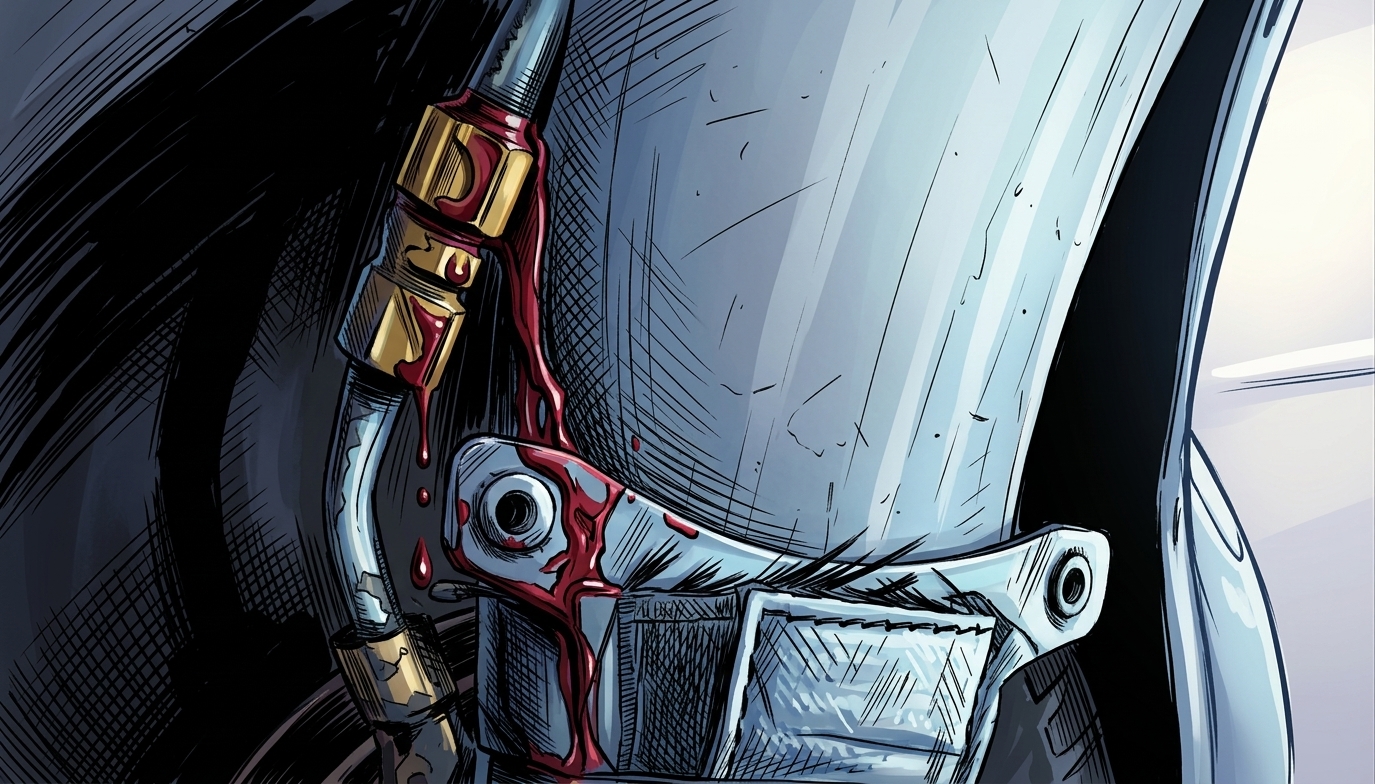
During a routine preflight, I noticed the brake fluid was lower than it should have been. I pulled the wheel pants, and it wasn’t subtle — there was an obvious leak right where the vinyl brake line connects to the left caliper. I taxied to the local shop to get it looked at, and by the time I got there, I had noticeably reduced braking on that side.
The shop had a story of their own. A few weeks earlier, another Sling TSi had come through their doors after a complete loss of brakes on landing rollout — the exact same failure point, but on the right wheel instead of the left.
That was enough to make me ask around. A quick check on the Sling TSi Discord turned up far more than I expected: multiple owners describing the identical failure — not leaks, but complete brake line failures — at that same caliper connection. One owner mentioned he’d already been telling Torrance about this directly. Others had already quietly fixed it themselves, on their own initiative, by swapping the vinyl for PTFE.
I brought the plane to Vertex Aviation, where they cut out the affected section of line, reattached it to the brake assembly, and flushed the system to get me flying again. That’s a repair, not a fix — I’m now researching what it takes to do the PTFE retrofit properly: the right material, the right fittings, and the right process for routing it through the gear leg.


Why Vinyl Fails Right There
Once the shop and the Discord thread lined up on the same failure point, I wanted to understand the actual mechanism — not just that this happens, but why it happens exactly where it does.
The stock Sling brake lines are vinyl/nylon plastic tubing, confirmed by builders on the Sling Pilots Forum, who note plainly that “standard lines for Sling are plastic tubing.” That’s not a Sling-specific shortcut — it’s the traditional homebuilder default, going back decades, because it’s cheap, flexible, and easy to route.
But that same tubing has a well-documented weakness, and it’s been documented for a long time. EAA’s own reference article on brake installations, written by Tony Bingelis back in 1987, states it directly: nylon brake lines “suffer from embrittlement when subjected to temperatures over 180 degrees F.” The article goes further, warning specifically that heat conducted from the wheel brake unit into the line is a real risk, and that the line should be insulated locally from that conducted heat. That’s a 39-year-old warning describing, almost word for word, the failure mode showing up on Sling TSis today.
180°F is not a high bar for a brake caliper. One TSi owner on the Discord thread described blowing out a line simply while seating a new set of brake pads over a weekend — routine maintenance, not abuse. Another described the same failure recurring after a first “fix” of just tightening the fitting, which only bought a few more flights before the leak came back. That pattern — tighten, fly, leak again — was the same one I saw with the shop’s earlier customer, and it matches what I found independently in an unrelated Sling TSi build blog describing a caliper-fitting leak that returned after flight testing, with no connection at all to the Discord conversation. Three separate builders, three separate airplanes, the same failure, the same location.
Some owners had already recognized this as a weak point before it bit them. One wrapped the plastic line near the caliper in thermal/exhaust-wrap material as a preventive measure — a reasonable instinct, but one that treats the symptom rather than the material.
The material comparison makes the case on its own. Nylon starts to embrittle above 180°F. PTFE (Teflon) has a usable range of roughly -65°C to 260°C — about -85°F to 500°F. That’s not a marginal improvement; it’s an entirely different category of heat tolerance, applied at the one point in the system that reliably gets hot.

It’s worth connecting this back to the Beringer decision. When I wrote about skipping Beringer brakes, the reasoning was cost, serviceability, and mission fit for cross-country flying — and none of that was wrong. But the Beringer wheel/brake kit ships with PTFE-lined braided lines standard. Line material wasn’t part of that comparison at all, because it wasn’t framed as a caliper decision — it’s a separate variable that applies regardless of which brakes are behind it, and one that can be addressed on the stock Matco setup without touching the rest of the system.
The PTFE Retrofit: How Owners Are Doing It
Once I started asking around, “use PTFE” turned out to be more than an abstract idea — several TSi owners have already done the swap and can describe exactly what it takes. Brian Olson is one of them: his advice and photos, shared in discussion on the TSi Discord, cover the process end to end, and he agreed to let me share it here.
Brian ran AN3 braided PTFE the whole way — from the caliper, through the airframe, out to the reservoir, with no plastic line left anywhere in the system. He’s running the upgraded dual-caliper Matcos, same as mine, so the parts list translates directly. Line and fittings can be built to length rather than bought as pre-made runs — a source like Aircraft Specialty’s DIY hose page sells AN3 PTFE hose and reusable fittings by the foot.

The gear leg is the tight part. Brian’s approach: enlarge both the entrance and exit holes in the gear leg carefully with a Dremel, just enough to give the line room to move. Make a clean cut in the braided line and wrap the cut end with a single layer of electrical tape so it doesn’t snag, then feed it up from the bottom of the gear leg. That’s the hardest part — getting it started into the hole takes some finesse — but once it’s in, you can work it upward until it exits the top, grab it with pliers, and keep pulling through. Plan on a foot or more of sacrificial length that gets trimmed off once it’s through and deformed; pull more than you think you need, then cut to fit. Repeat for the other leg. If a hole in the gear leg turns out tighter than expected, a sacrificial piece of the braided line doubles as a tool — work it through first to “sand” the hole from the inside before running the final piece. Brian ended up using roughly twice the PTFE he expected to need for the gear-leg section alone, just to be sure he had clean, undamaged line on the final pull. A dedicated braided-line cutter, rather than a hacksaw or standard tubing cutter, makes for a cleaner cut at both ends.
The wing-root connection is its own small piece of hardware. Brian’s line passes through the wing skin via an AN3 bulkhead fitting — a two-sided fitting that bolts through a drilled hole, secured with a locknut on the inside, so the braided PTFE connects to it from outside while the existing vinyl line from the reservoir connects to the same fitting from inside the cabin. That split is deliberate, not a shortcut: builders on other homebuilt forums note the same approach — nylon and vinyl line are generally considered fine on the low-pressure side, from the reservoir back through the cabin, since that run never sees the heat or pressure that builds up at the caliper end during braking. A grommet at the pass-through protects the line from chafing against the drilled edge of the skin.
What’s the Bar for Sling to Act?
It’s worth asking this plainly, and worth asking it fairly: at what point does a recurring, safety-relevant issue like this cross from “something builders quietly fix on their own” to “something the manufacturer addresses at the source”?
Start with the basic mechanics of how this works. The Sling TSi is experimental amateur-built (E-AB), which means whatever guidance Sling issues here — a Service Bulletin, an Information Letter, a Safety Alert — is voluntary, on their own initiative. There’s no outside body compelling them to act, the way there might be for a certificated aircraft. So the question isn’t really a regulatory one. It’s simpler than that: has Sling, in practice, treated this kind of issue as worth acting on before?
But “nobody can force their hand” isn’t the same as “they never act.” Sling’s own published Service Bulletin history shows a real pattern of doing exactly that, entirely on their own initiative, for issues that look a lot like this one:
| Service Bulletin | Component | Failure mode | Date issued |
|---|---|---|---|
| SB 0015 | Main axle mounts | Modified after field reports | 26 Mar 2019 |
| SB 0017 | Control stop plate rivets | Risk of shearing | 1 Jul 2020 |
| SB 0019 / 0024 | Throttle cable | Replacement required | 1 Oct 2021 (revised 2 Jun 2023) |
| SB 0021 | Elevator torque tube bushes | Missing locking bushes | 25 Jan 2023 |
| SB 0022 | Bolts | De-embrittlement | 2 Jun 2023 |
Every one of those is the same shape as this: a specific component, a known fatigue or material failure mode, reported from the field, addressed with a defined fix. That’s precedent, not speculation. It tells me Sling has, in the past, judged exactly this category of problem — narrow, safety-relevant, inexpensive to correct — worth a bulletin.
There’s also a cost dimension that’s hard to ignore. Swapping vinyl for PTFE line and AN fittings is a minor line-item cost at the factory level, nowhere near the cost of a landing gear redesign or a throttle cable replacement program. And the failure mode isn’t cosmetic — it’s a loss of braking on landing rollout, which is about as safety-relevant as a ground-handling failure gets. When the fix is cheap and the failure is serious, that’s usually the easiest case for a manufacturer to act on, not the hardest. It’s also a fair question of trade-offs: a manufacturer inevitably weighs the cost and complexity of a fleet-wide change against the severity of the issue, and this is a case where that scale seems to tip clearly toward acting — a low cost, high consequence problem with a fix already proven in the field by the very owners flying the airplane.
And this isn’t a case where Sling simply hasn’t heard about it. According to one owner on the TSi Discord, he’s been telling Torrance about this directly, and the vinyl lines are still what ships. I don’t know what’s happened on Sling’s end with that feedback, and I’m not going to speculate about it. But it does sharpen the question: this isn’t “does Sling know” so much as “what’s the threshold, once they do.”
I don’t think this is a case of Sling ignoring a safety issue out of indifference. Every builder program makes trade-offs between cost, complexity, and how many changes get pushed through a build line at once. But the pattern above suggests this specific kind of issue — a known material weakness, corroborated by multiple owners, with a proven low-cost fix already circulating in the community — is exactly the kind Sling has acted on before. That’s the standard I’d hold this one to, and it’s the standard I’ll be asking about when I file this with Sling directly.
My Plane: Where Things Stand
Stepping back from the industry-wide picture: my TSi is set up with the stock dual-caliper Matco brakes, upgraded from the single-caliper version of earlier TSi builds — a decision I documented in the Configuration Omnibus, alongside the original Beringer decision. Nothing about this changes my view on the calipers themselves. The dual-caliper Matcos have given me solid, predictable stopping power, and I’d make that choice again. This was never really a brakes problem — it was a brake line problem, and it turns out to be one that’s fully separable from which caliper is bolted to the axle.
That separability is actually the practical good news here. I don’t need to tear into a caliper swap or rethink the whole system. I need to replace roughly two feet of vinyl tubing per side with something that doesn’t care how hot the caliper gets.
The process itself — material, gear-leg routing, the wing-root connection — is laid out above, thanks to Brian. On my plane it’s still in the research phase, not the wrench phase: I’ve got the parts list and the process in hand, but haven’t pulled the old line yet.
In the meantime, I’ve filed a report through Sling’s ICE Reporting System — their formal channel for issues, concerns, and events — laying out exactly what happened: the leak, the reduced braking on taxi, the other TSi’s complete brake loss at the same failure point, and the pattern I found once I started asking around. Whatever Sling decides to do with that report is up to them. But at minimum, it’s now part of their record, not just a thread on Discord.
If you’re flying a Sling TSi with the stock vinyl brake lines, this is worth five minutes at your next preflight: pull the wheel pants and actually look at where the line meets the caliper. If it’s cracked or seeping, you’re not alone, and you’re not imagining it. And if you’ve seen this yourself, file an ICE report — the more of these that land on Sling’s desk with the same failure point, the harder it is to treat this as an isolated case.






Leave a Reply