
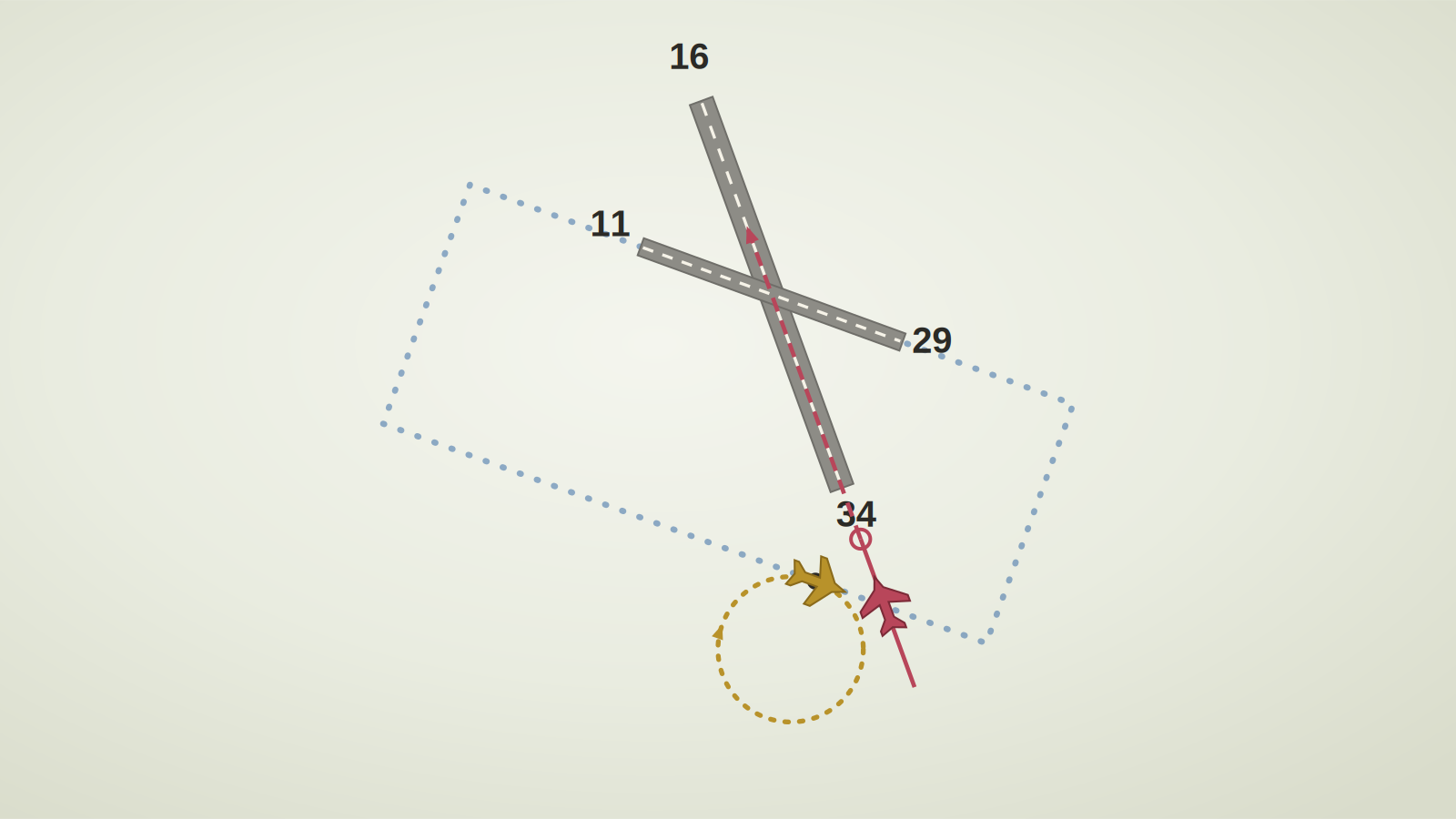
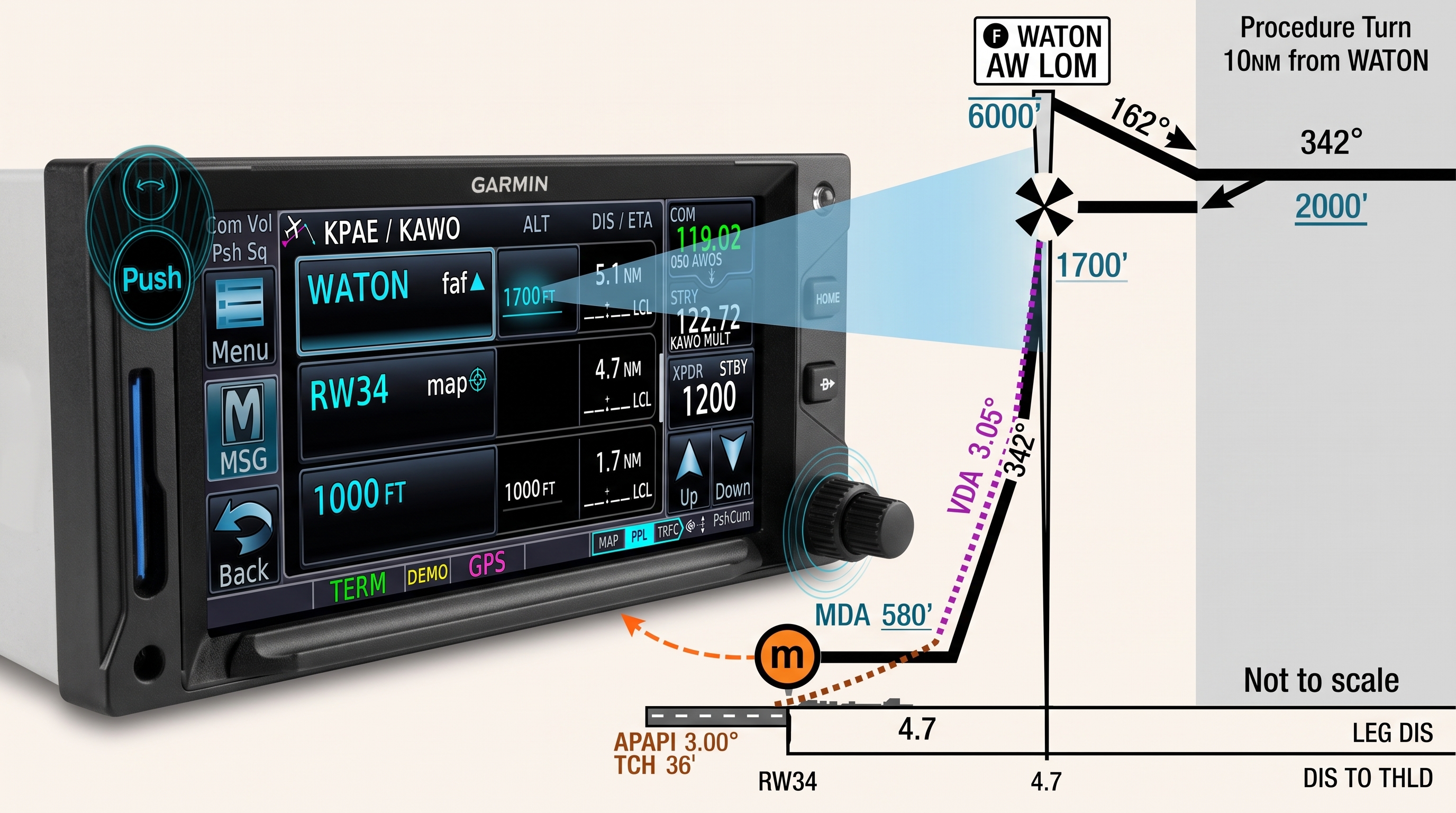
Downwind for 29 at KAWO, abeam the numbers, about to start down. Everyone in the pattern was using 29 — the wind made that the obvious call. But KAWO’s other runway, 34, is the only one here with an instrument approach, and someone was shooting practice approaches on it with a missed approach planned. Not a conflict yet. Fly the approach, fly the miss, climb out, no factor — as long as the miss happened on schedule.

It didn’t look like it was going to. The timing had that airplane arriving at decision altitude right about when I’d be turning base, which meant if they went missed even a little early, their climb-out and my base-to-final were going to want the same piece of sky.
I couldn’t turn around and look — no rear visibility from the seat. What I had was the radio calls and ADS-B, and both were telling me the geometry was closing. First move: check ADS-B and the last radio call for traffic behind me on downwind. Clear. Second move: key the mic. “N117ZS is going to make a three-sixty for spacing on downwind, traffic on the instrument approach to 34.” Third move: fly the circle — a standard-rate turn, two full minutes, altitude held, eyes on the target the entire way around. Two minutes later I rolled back out on downwind in the same spot I’d left it, sequence intact, timing fixed — except for the guy who’d just watched the whole thing happen and decided he had something to say about it.
The Pattern Sheriff
The radio call came about ten seconds after I rolled out — not from anyone in the pattern, but from the ground at KAWO. Which tracked, because if you fly out of this field long enough you learn there’s always a guy on the ground with a handheld and an opinion, and he has a reputation. Ask around and pilots will tell you: he doesn’t just comment, he chastises — a running hobby of citing regulation at whoever keys the mic wrong that day. This time it was my turn.
“N117ZS, be advised, three-sixties in the pattern are not standard procedure.”
Not a question. A ruling. I’ll call him the Pattern Sheriff (the aviation equivalent of the Soup Nazi), because that’s exactly the energy — badge pinned on, squinting at the horizon from a folding chair somewhere outside the fence, ready to cite the next pilot who breaks form.
He wasn’t making it up. That line exists — almost word for word — in the AIM. He’d clearly read it, or absorbed it secondhand from someone who had, and he was applying it with total confidence to the situation unfolding in front of him. There was just one problem: he was citing the wrong jurisdiction.
Wrong Jurisdiction
Here’s the thing about that line in the AIM: it’s true, and it’s also not about this.
Pull up the actual text and it’s precise about who it’s talking to. AIM 4-3-6 describes a controller building a landing sequence out of observed traffic, pilot reports, and anticipated maneuvers — noting that he can absorb something like a shallow S-turn, but not a 360, without warning. AIM 4-3-5 goes further, framed explicitly around radar service: a 360 shouldn’t be flown in the pattern or under radar without advising the controller first, except in an emergency or when the controller requests it himself.
Same phrase does the load-bearing work in both passages: the controller. Not “other pilots.” Not “traffic in the area.” A specific person, in a specific role, sequencing arrivals by radio and depending on every airplane staying roughly where he last put it. A 360 disrupts that picture — that’s the entire basis for the caution, not that the maneuver is inherently reckless.
Take the controller out of the equation and the caution doesn’t transfer. There was no one at KAWO building a sequence, no one with a mental model of the pattern for my 360 to scramble. There was a shared frequency and a handful of pilots each responsible for their own airplane — a real system, with its own real rules. Just not the ones the Pattern Sheriff was quoting.
The Untowered Rulebook
So what rules actually apply at a field like KAWO? Start with FAR 91.126 and 91.127, which govern operations at airports without an operating control tower: fly the pattern, turn left unless the airport says otherwise, and — this is the part that matters here — nothing in either regulation prescribes how a pilot may adjust within that pattern to maintain safe spacing. The FAA’s own advisory circular on the subject, AC 90-66C, fills in the rest: it lays out standard entries, pattern altitudes, and radio calls, but it’s explicit that these are recommended practices, not a rigid script that overrides a pilot’s judgment in the moment.
That judgment has a name: FAR 91.3, pilot-in-command authority. The PIC is directly responsible for, and is the final authority on, the operation of the aircraft. At a towered field, that authority operates inside a system run by someone else — you fly your airplane, but the controller owns the sequence. At an untowered field, there’s no one else running the sequence. You own it. Layer in FAR 91.113 — the general right-of-way and see-and-avoid rule that governs how aircraft deal with each other absent ATC — and the picture is complete: no controller, no assigned sequence, just PIC authority and an obligation to avoid the other guy.
That obligation is also exactly where a 360 stops being free. The maneuver only works if you actually know what’s behind you, and at a lot of planes — mine included, no rear visibility from the seat — “knowing” means radio calls and ADS-B, not eyes. Both of those have blind spots. A NORDO airplane, or one that’s equipped but hasn’t made a call, won’t show up in either. That’s the real risk in a 360, not the maneuver itself: it takes two minutes, during which the traffic picture can change, and it demands that you keep working that picture the entire way around the circle — not just clear it once before you start turning and then stop looking. Confirm before you turn, and keep confirming while you’re in it.
None of this is fringe reading. It’s the same conclusion pilots reach independently, all the time, in the places pilots actually talk about pattern work. AOPA has run training tips describing a 360 for spacing as a legitimate, teachable tool — including one where a flight instructor narrates doing exactly that, out loud, as a demonstration of good habits for a student. Pattern forums are full of the same consensus, with the same two caveats every time: confirm nobody’s behind you, and say what you’re doing before you turn. Which is, item for item, the checklist I ran.

The Verdict
So — was it legal? Was it good airmanship? Both, and it’s worth being precise about why, because the Pattern Sheriff wasn’t wrong about the rule. He was wrong about which rule.
The Verdict
A 360 for spacing in the pattern isn’t a violation at an untowered field — the AIM caution against it is written for a towered, radar-managed environment where an unannounced 360 breaks a sequence someone else is actively building. Take the controller out of the picture and that basis disappears. What’s left is PIC authority, see-and-avoid, and a maneuver that’s well established as a legitimate spacing tool — provided it’s flown the way it’s supposed to be.
- Confirm what’s behind you before you turn — radio calls, ADS-B, whatever situational awareness you’ve got
- Announce it on frequency before you start the turn, not after
- Keep working the traffic picture for the full two minutes, not just at the start
- Know which rule applies where — towered sequencing versus untowered PIC authority are two different systems with two different sets of expectations
One More Thing, Sheriff
To the guy on the ground at KAWO: the AIM citation was solid work. Chapter and verse, basically word for word. If there were a written test for Pattern Sheriff, you’d pass with room to spare.
But the badge only has jurisdiction at towered fields, and KAWO doesn’t have a tower. It has a frequency, a windsock, and a bunch of pilots doing their own sequencing — including, that day, one who checked his six the only way he could, made the call, flew the circle, and rolled back out exactly where he left off. No harm, no foul, no need for backup.
Catch you on 122.8.




Leave a Reply