

One of the joys—and let’s be honest, headaches—of building an experimental aircraft is that you get to choose everything. It’s a blank canvas with wings. Paint? Your call. Interior? Knock yourself out. Avionics? Welcome to the deep end of the rabbit hole.
For the avionics in my Sling TSi, I made the decision early on to go almost all-in with Garmin. Why? Because when you’re building something as complex as an IFR-capable airplane, it pays to go with a cohesive, well-supported ecosystem. Garmin doesn’t just make radios and glass panels—they make a full suite of integrated systems that talk to each other natively, supported by a vast user community, rock-solid documentation, and specialized builders like Midwest Panel Builders who know these components inside and out.
Could I have mixed and matched brands? Sure. As an experimental aircraft builder, I have total freedom. But Garmin’s lineup for the experimental market is honestly exceptional—not just in capabilities, but also in how well everything fits together. From autopilots to engine monitoring to Bluetooth audio, Garmin offers a truly end-to-end solution.

In this post, I’ll walk through the avionics I chose for my Sling TSi, organized by function. Each component plays a specific role, and together, they form a panel that I think balances capability, safety, and future-proofing—with just a touch of nerdy elegance.
And here’s something worth pausing on: until very recently, this level of avionics was reserved for airliners or corporate jets. In some cases, my panel actually surpasses what many commercial pilots are flying with. That’s the wild beauty of experimental aviation today—we’re putting world-class capability in personal airplanes.
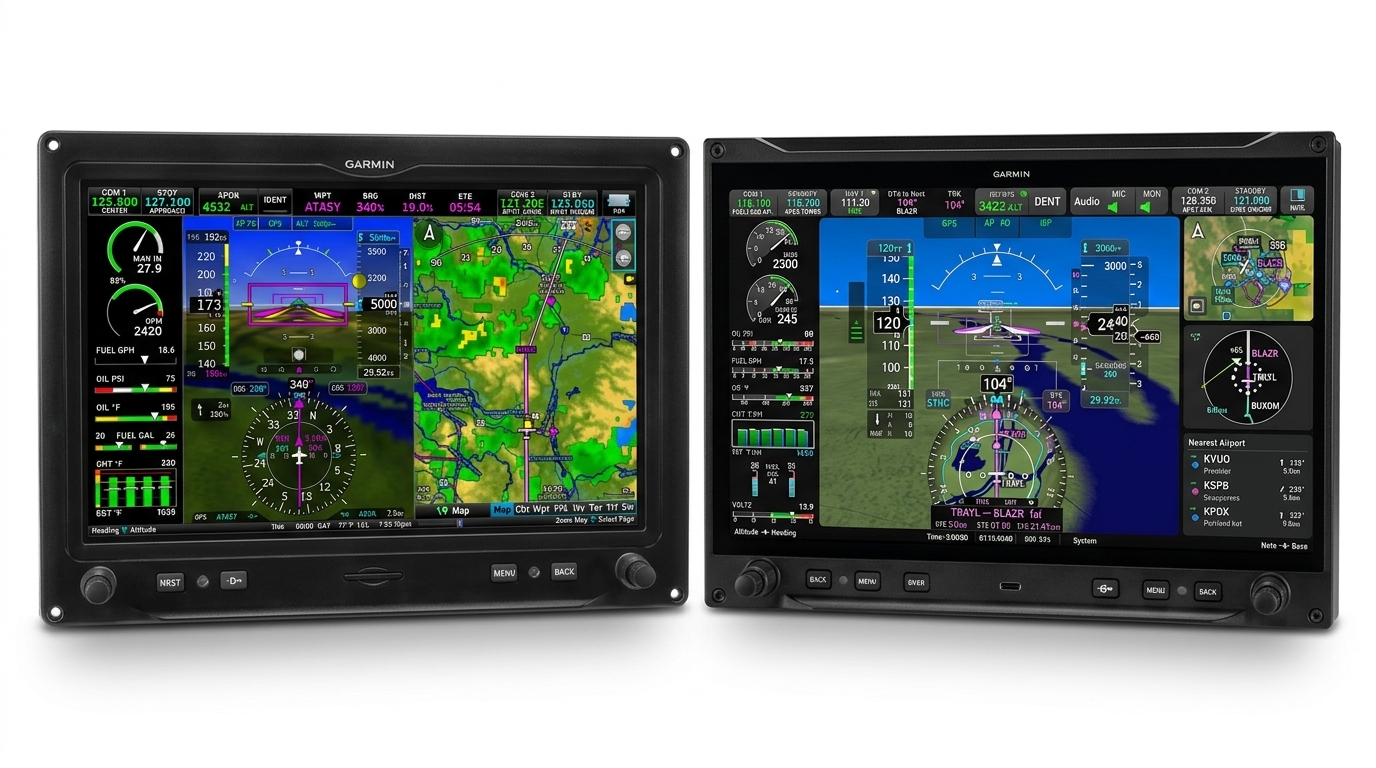
MFD/PFD: Garmin G3X Touch (x2)
When it comes to experimental EFIS systems, the Garmin G3X Touch is the undisputed heavyweight champ. It’s not just a screen—it’s the brains, the nerves, and the eyes of the airplane all in one slick touchscreen interface. This thing is a beast.

Here’s what makes it so compelling:
- Brilliant Touch Interface: The capacitive touchscreen is fast, responsive, and glove-friendly. Garmin nailed the UI—everything is intuitive, from map manipulation to customizing engine gauges.
- Synthetic Vision Technology (SVT): Think video game realism. You get a 3D view of terrain, runways, obstacles, and even flight path markers. Great for situational awareness, especially in low visibility.
- Full Engine Monitoring: Oil temp, cylinder head temps, fuel flow, manifold pressure—you name it. You can set custom alerts for pretty much anything. It’s like having a virtual flight engineer.
- ADS-B Integration: When paired with a compatible transponder (like my GTX 45R), the G3X overlays ADS-B IN weather and traffic directly on the moving map.
- Integrated Autopilot Control: The G3X isn’t just displaying flight data—it can also command the autopilot (in my case, the GFC 507). All modes, altitude preselect, and vertical nav can be accessed right from the EFIS.
- Wireless Connectivity: With Garmin Connext, it can sync with ForeFlight or Garmin Pilot on an iPad, making data sharing and flight planning seamless.
- Flight Plan Management: You can create, edit, and activate flight plans directly from the G3X. No need to go fiddling with a separate navigator just to change a leg or load an approach.
- Geo-referenced Approach Plates and Charts: Add a Garmin ChartView subscription, and you’ve got FAA plates and enroute charts integrated right on your EFIS display.
- Expandable Architecture: Want to add more toys later (radar altimeter, angle of attack sensor, additional displays)? G3X plays nice with Garmin’s full avionics suite, so you’re future-proofed.
From Aviation Consumer’s review:
“…the G3X Touch is more than just a primary flight display—it’s a full systems manager, autopilot controller, and mission coordinator, all packed into a beautiful touchscreen package.”
For my build, I chose two G3X Touch displays—a primary on the pilot side and a secondary on the right. Here’s why:
- Redundancy: If one fails, I still have complete control and visibility.
- Task Separation: Left for PFD + engine monitoring; right for MFD with maps, traffic, weather, and charts.
- Flight Planning Efficiency: With my iPad running ForeFlight doing preflight duties, the G3X picks up in the cockpit with total situational awareness.
This setup brings a level of automation, clarity, and safety that was fantasy-level stuff in GA even a decade ago.
WAAS GPS/NAV/COM: Garmin GTN 650Xi
If the G3X Touch is the brain of the panel, the GTN 650Xi is the seasoned navigator—calm, fast, and packed with IFR smarts. The 650Xi is Garmin’s next-gen take on the popular GTN 650, and it brings a ton of capability in a compact, crisp, and very touchscreen-friendly package.

Capabilities:
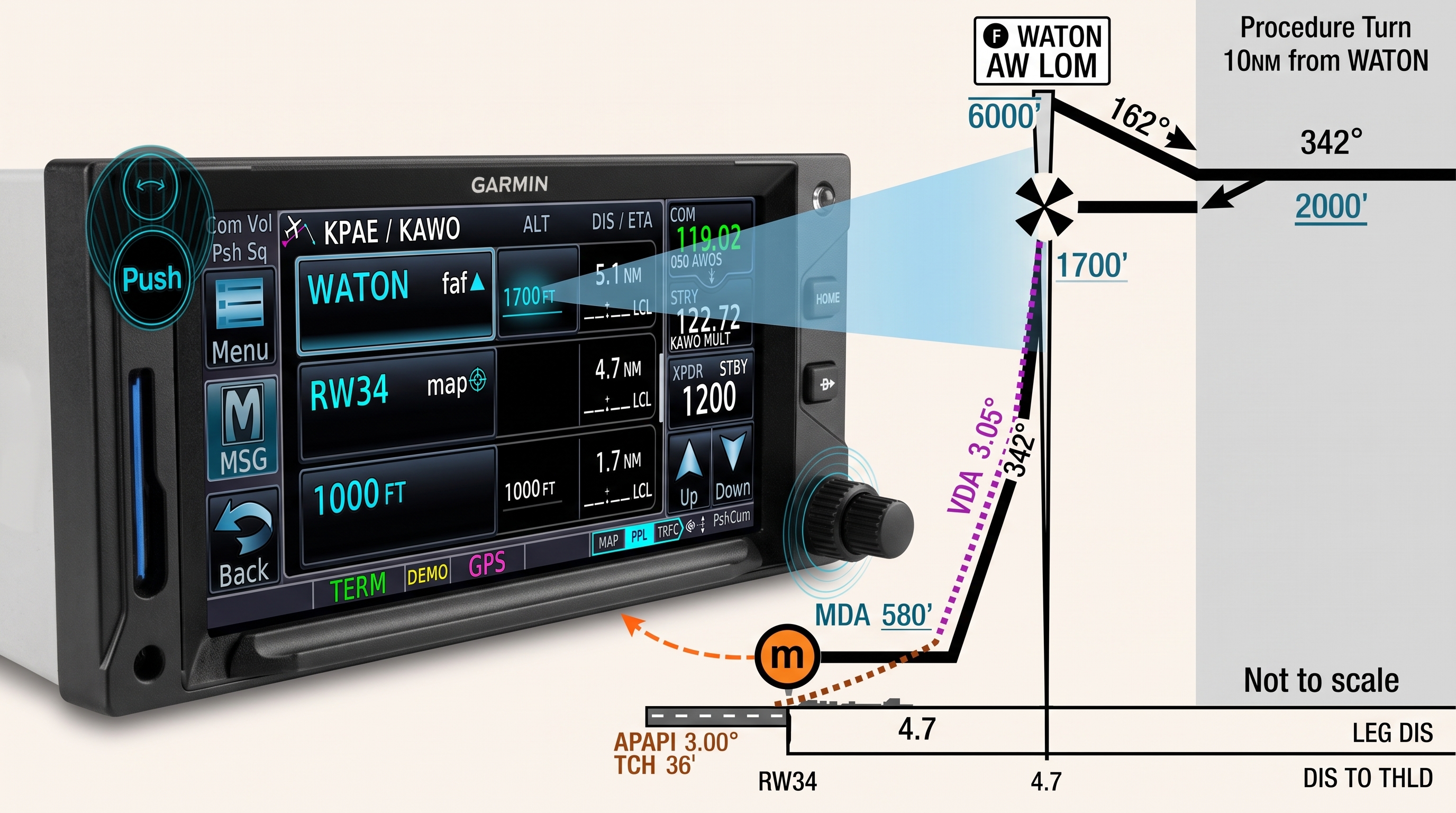
- WAAS-Enabled GPS Navigator: This is your primary IFR navigator, certified for everything from enroute to LPV (Localizer Performance with Vertical Guidance) approaches. It brings ILS-like precision to airports that don’t have traditional nav aids.
- Full COM/NAV Radio: With both VHF comm and VOR/ILS nav, this unit handles all your radio needs with 10-watt transmit power and the ability to store up to 15 frequencies.
- Fast Touchscreen Interface: The 650Xi boots faster, renders faster, and responds quicker than its predecessor. Garmin claims it’s “more than 50% faster,” and it feels it.
- Advanced Flight Planning: You can build, load, and activate flight plans and instrument procedures. It syncs seamlessly with the G3X Touch, so you can push flight plans from one to the other with ease.
- Visual Approaches: The GTN 650Xi can generate its own GPS-based visual approach with guidance to any runway, taking into account terrain and obstacles.
- Traffic and Weather Display: With ADS-B IN and other sources available from the G3X system, the GTN can also display traffic and NEXRAD radar overlays, either standalone or mirrored from other units.
- Built-in Terrain and Obstacle Awareness: Color-coded terrain warnings and aural alerts keep you out of trouble, even in VFR into IMC-type situations.
- Fully Integrated with Other Garmin Gear: The GTN acts as a flight plan master and COM/NAV hub, tightly coupled with the G3X Touch and GFC 507 autopilot.
According to Flying Magazine, the GTN Xi line represents “a major leap in interface responsiveness and screen readability,” which is critical when you’re head-down in the soup trying to load an approach at the last minute.
Why I Picked the 650Xi (Not the 750Xi)
The GTN 750Xi is the big sibling—it’s got all the same capabilities but adds a larger display. So why didn’t I go for it?
- Cost: The 750Xi adds several thousand dollars to the price tag, and the functional benefits don’t match the cost in my setup.
- Display Real Estate: With dual G3X displays, I already have large moving maps and multi-panel situational awareness. I didn’t need a third big screen just to duplicate info.
- Panel Real Estate: More screen = more space taken up on the panel. The 650Xi leaves me room for cleaner layout and future flexibility.
The 650Xi strikes the right balance: It’s a compact, powerful IFR navigator that works beautifully with the rest of the Garmin suite. It’s also one of the most respected, capable units in general aviation, both certified and experimental.
Backup EFIS: Garmin G5
In aviation, redundancy isn’t just a nice-to-have—it’s a philosophy. That’s where the Garmin G5 comes in. While the G3X Touch handles most of the heavy lifting in my panel, the G5 stands ready in case things go sideways. And it’s far from a second-rate backup—this thing is surprisingly powerful.

Capabilities:
- Primary Attitude Reference: The G5 displays a full artificial horizon with pitch, roll, and slip/skid information—just like a traditional attitude indicator, but sharper, faster, and digital.
- Heading & HSI Display: It can serve as a DG or full HSI with GPS/VOR/LOC guidance, depending on how it’s configured. That means you can shoot an ILS or LPV approach with nothing but the G5 and GTN 650Xi if necessary.
- 4-Hour Internal Battery Backup: If the rest of the electrical system goes dark, the G5 stays alive for up to four hours. That’s more than enough to get you out of IMC and on the ground safely.
- Standalone or Integrated: It can operate independently, but also integrates with Garmin navigators and autopilots. Even in standalone mode, it provides heading, altitude, airspeed, and vertical speed.
- Digital Precision, No Vacuum System: One of the best parts? No vacuum pump. Say goodbye to the weak link of so many legacy GA panels. The G5 is all solid-state, reliable, and much less prone to failure.
From Aviation Consumer:
“The G5 essentially redefined what a backup instrument could be… It’s affordable, compact, and infinitely more useful than any steam gauge it replaces.”
Why I Chose It:
Honestly, it was a no-brainer. The G5 is FAA-approved even for certified aircraft as a standalone backup AI. In an experimental aircraft like the Sling TSi, where the G3X system is the main interface for flight data, the G5 provides peace of mind and true backup capability without compromise.
It’s compact, draws minimal power, and adds a huge layer of resilience to the panel. If the G3X and GTN go out (lightning strike? electrical gremlins? zombie apocalypse?), the G5 and its internal battery will get me safely to an airport.
Autopilot: Garmin GFC 507
An autopilot used to be a luxury in experimental aircraft. Now? It’s almost non-negotiable, especially if you’re flying IFR, going cross-country, or just want to focus on managing the flight instead of manually chasing needles for hours. Enter the Garmin GFC 507—a purpose-built, digital autopilot that integrates tightly with the G3X Touch and GTN 650Xi.

Capabilities:
- Digital, Servo-Based Precision: The GFC 507 is a fully digital autopilot with brushless DC servos—no clunky mechanical parts, no cable slop. The result? Smooth, fast, accurate control that feels like you’re riding on rails.
- Flight Director Integration: The system includes a full-featured flight director that displays on the G3X, giving you pitch and roll cues whether you’re hand-flying or letting the autopilot do the work.
- Envelope Protection (ESP): This is Garmin’s way of watching your back. If you start to exceed safe pitch, bank, or airspeed limits—even with the autopilot off—the system gently nudges the controls to get you back in the box.
- Emergency Level Mode: One button. One job. Push it, and the GFC 507 brings the aircraft to straight-and-level flight. No questions asked. This is the kind of feature that turns a bad day into just a mildly embarrassing story later.
- VNAV Capability: When paired with the GTN 650Xi, it can fly vertical navigation profiles, meaning step-downs, crossing restrictions, and other vertical guidance—all without you needing to touch the controls.
- Altitude Preselect and Climb/Descent Modes: You can dial in your desired altitude, and the GFC 507 will climb or descend at a preselected vertical speed or pitch.
- Full IFR Flight Plan Integration: It can fly published approaches, intercept radials, hold altitudes, and handle pretty much anything you’d throw at a certified autopilot.
As Aviation Consumer puts it:
“The GFC 507 is one of Garmin’s most successful experiments—blending the precision of certified tech with the flexibility and modularity of the experimental world.”
Why I Chose It:
This was another easy yes. The GFC 507 works seamlessly with my dual G3X Touch setup and GTN 650Xi, creating a tight avionics ecosystem. I wanted something:
- Safe (ESP + Level Mode)
- Integrated (G3X control panel + flight director)
- Capable (IFR VNAV, approach flying)
- Trusted (widely used across experimental and certified aircraft)
It’s hard to overstate how much this autopilot reduces workload—especially on long flights or in IMC. It lets me focus on the “big picture” of flying the mission, not just the mechanics of stick and rudder.
Radios & Audio Integration: GTN 650Xi + GTR 205XR + GMA 245R
Alright, let’s dig into the radio and audio panel setup. While it may not have the wow-factor of a synthetic vision display or an autopilot doing an LPV approach hands-off, solid communication gear is the unsung hero of every IFR panel. And in this build, you’ve got a smart, streamlined combo that makes cockpit comms smooth and stress-free.
Primary Comm: GTN 650Xi
The GTN 650Xi isn’t just a navigator—it’s also a full-featured VHF COM radio, with 10-watt transmit power and the ability to store commonly used frequencies. It integrates seamlessly with the rest of the Garmin suite, letting you pull up ATIS, switch between ATC frequencies, and quickly swap active/standby with a tap. This serves as your primary COM1.
But redundancy and flexibility matter—especially when you’re IFR and working approach, center, tower, and your favorite airport diner frequency all in one flight.
Secondary Comm: Garmin GTR 205XR
Enter the Garmin GTR 205XR. This is your COM2—a lightweight, reliable backup radio that punches above its weight:
- 25 kHz or 8.33 kHz spacing: So you’re covered both in the U.S. and abroad (hello, future trips to Canada or Europe).
- Flip-flop standby/active: With an easy-to-read screen and user-friendly knob/touch controls.
- 100 user-stored frequencies: With editable identifiers—no more wondering if “122.8” is that one fuel stop or the other fuel stop.
- Emergency Tuning: One-touch access to 121.5 in case things go sideways.
Having a second radio means you can monitor ATIS or CTAF while still talking to ATC. It’s also your “just-in-case” backup if something goes wrong with the GTN or if you’re flying with a copilot who wants to handle comms separately.
Audio Integration: Garmin GMA 245R Audio Panel
The glue that brings it all together is the Garmin GMA 245R—the remote-mounted audio panel controlled through the G3X Touch. This might be one of the most underappreciated pieces of avionics tech in the panel.
Here’s why it matters:
- Bluetooth Audio & Phone Integration: You can wirelessly connect your iPhone or tablet, stream music, or make a phone call through your headset while on the ground. It’s like your car’s infotainment system… only in a plane.
- 3D Audio Processing: This spatially separates different radio channels in your headset—COM1 sounds like it’s coming from the left, COM2 from the right. It’s subtle but makes simultaneous audio way easier to understand.
- Split Comms & Intercom: You and your copilot can transmit on different radios or isolate yourselves from passengers. Super useful for flight training or when someone in the right seat really wants to tell you about last night’s pasta recipe mid-approach.
- Integration with G3X: You control the whole thing from your touchscreen. No separate panel, no clutter, and full customization.
In short, this trio—GTN 650Xi + GTR 205XR + GMA 245R—gives you professional-grade comms, smart redundancy, and cockpit harmony. You can monitor, transmit, switch, isolate, stream, and even jam to Spotify at 9,000 feet (if that’s your thing—Opeth, maybe?).
The Supporting Cast: Utility & Safety Systems
These components may not take center stage in the avionics lineup, but they quietly make your aircraft a better, safer, and more comfortable place to fly.
Garmin GHA 15: Radar-Based Height Awareness
The GHA 15 is a compact, radar-based height awareness system that measures the aircraft’s height above terrain during the approach and landing phases—up to 500 feet AGL.
- Accurate Touchdown Awareness: It gives you a callout (like “100 feet”) similar to what you’d hear in an airliner, helping fine-tune your flare timing and confidence in low visibility.
- No GPS Lag: Because it’s radar-based, the measurements are instantaneous and unaffected by GPS lag or barometric drift.
- Pilot Training & Safety Aid: Especially helpful in the Sling TSi where you might be transitioning from more traditional GA aircraft. The GHA 15 provides valuable cues for consistent landings.
Garmin GCO 14: Carbon Monoxide Detector
CO poisoning in GA aircraft is insidious—and avoidable. The Garmin GCO 14 continuously monitors cabin air and:
- Provides Visual and Aural Alerts: If CO levels rise above safe thresholds.
- Integrates with the G3X: So warnings appear directly on your main screen—no squinting at a tiny LED buried behind your panel.
- Critical for Peace of Mind: Especially in winter or on long cross-country flights with less-than-perfect cabin seals.
Garmin GDL 51

The Garmin GDL51 is a portable SiriusXM receiver that provides weather and entertainment data to Garmin Pilot or ForeFlight. I chose the portable version over the panel-mounted Garmin Sirius XM components because it includes its own built-in AHRS, battery, and costs substantially less. That means in a catastrophic electrical failure, I still have access to attitude and heading information—yet another layer of backup.
LEMO Headset Plugs
You’ve upgraded your headset (Bose A30, nice choice), so why mess around with dual plugs and batteries?
- Powered Connection: LEMO (aka “Redel”) plugs provide aircraft power directly to your ANR headset—no more swapping AA batteries mid-flight.
- Clean Install: Fewer cables, less clutter, more comfort.
- Future-Proof: Works with all high-end ANR headsets (Lightspeed, Bose, etc.)
12V Power Plug (aka Car Plug) for Oxygen Concentrator
Given my plan to occasionally cruise at altitudes up to 18,000 feet, I will be bringing an oxygen concentrator on board.
- Dedicated Power for O2: The 12V port ensures you can run the oxygen concentrator (like the Imogen Aviator) without worrying about battery life.
- Standard Port: It’s the classic car-style socket, so it can power other gear too (portable ADS-B receivers, phones, coffee warmers—whatever you’re into).
USB Ports
This is 2025. Charging your iPad, phone, or GoPro mid-flight isn’t optional—it’s essential.
- Panel-Mounted USB-C and USB-A Ports: Keep all your gadgets charged and happy.
- High-Power Output: Enough juice to keep an iPad running full brightness with ForeFlight and Bluetooth on.
- Strategic Placement: Positioned so cables aren’t in your way during critical phases of flight.
Wrapping Up
This avionics suite isn’t just a panel—it’s an ecosystem. Every component works together to reduce workload, increase safety, and bring airline-level capability into a two-seat experimental aircraft.
And best of all? It’s yours—custom-built for your brain, your flying style, and your vision of what an airplane should be.




Leave a Reply